Showing posts with label phytosaurs. Show all posts

New Triassic Vertebrate Papers and the Cold Case of the Phytosaurs

After an almost three year hiatus I am looking to start posting again. Is anyone still out there? Did anyone miss me?

Here are a few new Triassic papers officially out today, all open access. A couple were out as early access, but the new phytosaur phylogeny paper is new today in PeerJ. This represents the bulk of the senior authors dissertation, is an exhaustive analysis of the phytosaurs, and a great exercise in database exploration for a group that has been particularly troublesome to deal with taxonomically and phylogenetically.

Phytosaurs are an incredible group of archosauriforms, common in Late Triassic rocks. Although problematic they serve as a great group for students to learn basic cranial and skeletal anatomy and we use them for this purpose at the Petrified Forest. Numerous and diverse they go extinct at the end of the Triassic and that is a mystery that colleagues such as Randall Irmis from the University of Utah are trying to solve. This research was featured last week on Science Friday.

Jones, A. S., and R. J. Butler. 2018. A new phylogenetic analysis of Phytosauria (Archosauria: Pseudosuchia) with the application of continuous and geometric morphometric character coding. PeerJ 6:e5901 DOI 10.7717/peerj.5901

 Marsola, J. C. A., Bittencourt, J. S., Da Rosa, Á. A. S., Martinelli, A. G., Ribeiro, A. M., Ferigolo, J., and M. C. Langer.  2018. New sauropodomorph and cynodont remains from the Late Triassic Sacisaurus site in southern Brazil and its stratigraphic position in the Norian Caturrita Formation. Acta Palaeontologica Polonica 63 (4): 653–669.

Niedźwiedzki, G. and E. Budziszewska-Karwowska. 2018. A new occurrence of the Late Triassic archosaur Smok in southern Poland. Acta Palaeontologica Polonica 68 (4): 703–712.

De Oliveira, T. M., Oliveira, D., Schultz, C. L., Kerber, L., and F. L. Pinheiro. 2018. Tanystropheid archosauromorphs in the Lower Triassic of Gondwana. Acta Palaeontologica Polonica 63 (4): 713–723.


Lithostratigraphy and biostratigraphy of the Chinle Formation in Lisbon Valley, Utah

The stratigraphy of the Chinle Formation in Lisbon Valley, Utah has been somewhat controversial. This paper is the result of several seasons of fieldwork and provides an intense revision of the local stratigraphy as well as discussion of the fossils found in these rocks. Martz et al. provide a large amount of information and are careful to make sure that their work is repeatable as possible. To this end they provide coordinates and labelled photos of their measured sections as well as a list of voucher specimens for all of the fossil taxa. Martz's work continues to raise the bar not only for studies in the Upper Triassic of Utah, but also for stratigraphic and biostratigraphic work in general.


Martz, J. W., Irmis, R. B., and A.R.C. Milner. 2014. Lithostratigraphy and biostratigraphy of the Chinle Formation (Upper Triassic) in southern Lisbon Valley, southeastern Utah; pp. 397-448 in MacLean, J.S., Biek, R.F., and J.E. Huntoon (eds.), Geology of Utah's Far South. Utah Geological Association Publication 43.

Abstract - We present here a detailed study of the lithostratigraphy and preliminary vertebrate biostratigraphy of the Upper Triassic Chinle Formation in Lisbon Valley, southeastern Utah. Triassic salt tectonism resulted in a period of erosion and possibly non-deposition that removed the top of the Lower Permian Cutler Group, the Early-Middle Triassic Moenkopi Formation, and the Late Triassic (earliest Norian) Shinarump Member of the Chinle Formation. Chinle Formation deposition in Lisbon Valley began or resumed sometime during the middle-late Norian or Rhaetian and terminated before the end of the Rhaetian. Chinle Formation sediments are mostly siltstone to fine-grained sandstone dominated by planar cross-bedding and climbing ripple cross-lamination; these sediments generally exhibit poor paleosol development, with interbedded conglomerates dominated by clasts composed of reworked intrabasinal sediments and containing only minor extrabasinal silica. The regional climate during Chinle deposition was becoming increasingly arid, with fluctuating seasonal rainfall. Deposition by the braided and meandering rivers of the lower Kane Springs beds filled paleovalleys incised into the Cutler Group, and was followed by a poorly drained interval of poorly oxygenated swamps and lakes crisscrossed by small streams that produced the middle Kane Springs beds. These conditions transitioned back to the slowly aggrading braided and meandering rivers of the upper Kane Springs beds, probably by Rhaetian time. The Kane Springs paleoenvironment, probably at least partially syndepositional with that of the Owl Rock Member, was inhabited by conifers, freshwater ostracods, bivalves and gastropods, indeterminate phytosaurs, and the aetosaur Typothorax. The shift to the overlying Church Rock Member was gradational and probably involved only subtle shifts in the depositional system, largely related to better-drained sediments. Braided channels with seasonally variable discharge crossed well-drained, rapidly aggrading and well-oxygenated floodplains. Rare paleosols (including entisols, vertisols, and aridisols) indicate seasonal wetting and drying in a generally arid climate. Rivers and lakes were inhabited by the phytosaur taxon Machaeroprosopus (including the derived form “Redondasaurus”), rare metoposaurids, coelacanths, a diverse actinopterygian fish fauna, conchostracans, ostracods, bivalves, and gastropods. The flora included conifer trees, giant horsetails, Cynepteris (a fern), Zamites (a bennettitalean), the small shrub-like conifer Pelourdea, and the enigmatic Sanmiguelia. Terrestrial tetrapods included the aetosaur Typothorax (suggesting that the genus endured into the Rhaetian), paracrocodylomorphs, and small theropods. Eventually, wind-blown eolian deposits entered the region, and late in the Rhaetian, prior to 201.3 Ma, the eolian Wingate erg swamped small braided channels still inhabited by the phytosaur “Redondasaurus,” actinopterygian fishes, and small theropods.

Evidence of Trophic Interactions Among Apex Predators in the Late Triassic

Let's get back into the swing of things Chinle with this new paper that shows how badass phytosaurs were. I'd love to see someone recreate this fight scene for a film.

Drumheller, S. K., Stocker, M. R., and S. J. Nesbitt. 2014. Direct evidence of trophic interactions among apex predators in the Late Triassic of western North America. Naturwissenschaften (advance online publication) DOI: 10.1007/s00114-014-1238-3

 Abstract - Hypotheses of feeding behaviors and community structure are testable with rare direct evidence of trophic interactions in the fossil record (e.g., bite marks). We present evidence of four predation, scavenging, and/or interspecific fighting events involving two large paracrocodylomorphs (='rauisuchians') from the Upper Triassic Chinle Formation (~220–210 Ma). The larger femur preserves a rare history of interactions with multiple actors prior to and after death of this ~8–9-m individual. A large embedded tooth crown and punctures, all of which display reaction tissue formed through healing, record evidence of a failed attack on this individual. The second paracrocodylomorph femur exhibits four unhealed bite marks, indicating the animal either did not survive the attack or was scavenged soon after death. The combination of character states observed (e.g., morphology of the embedded tooth, ‘D’-shaped punctures, evidence of bicarination of the marking teeth, spacing of potentially serial marks) indicates that large phytosaurs were actors in both cases. Our analysis of these specimens demonstrates phytosaurs targeted large paracrocodylomorphs in these Late Triassic ecosystems. Previous distinctions between 'aquatic' and 'terrestrial' Late Triassic trophic structures were overly simplistic and built upon mistaken paleoecological assumptions; we show they were intimately connected at the highest trophic levels. Our data also support that size cannot be the sole factor in determining trophic status. Furthermore, these marks provide an opportunity to start exploring the seemingly unbalanced terrestrial ecosystems from the Late Triassic of North America, in which large carnivores far outnumber herbivores in terms of both abundance and diversity.

Ice Archosauromorph


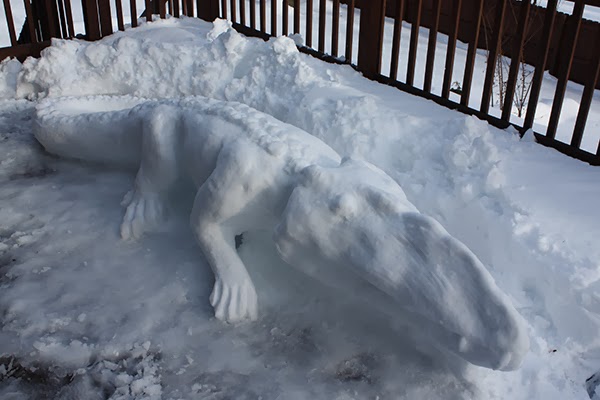
 Recent retreat of ancient ice sheets from western Virginia has revealed the frozen exquisitely preserved remains of a phytosaurian archosaur. The specimen appears to be of the fully crested type, similar to Nicrosaurus kapffi, previously only known from Germany. As the photos below demonstrate, even details of the soft tissue are preserved giving us amazing insight of this animal such as proportions, posture, and that it had bulgy eyeballs. 


 A close-up of the pes shows that digit four is the longest, supporting the hypothesis that the ichnoform Apatopus is indeed the track of phytosaurians.


Discoverers Michelle Stocker and Sterling Nesbitt are taking measurements and describing the new find before the Spring thaw, hopefully publishing the results soon.  In the meantime they are also eagerly awaiting what other rare forms may be exposed as these thick deposits of eastern ice finally retreat.