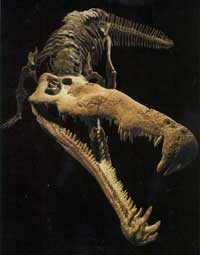
rutgerjansma answered both quickly and correctly. Mystery fossil #3 is the holotype skull of the phytosaur
Pseudopalatus jablonskiae named by myself and Randall Irmis in 2006. This skull was collected from the Sonsela Member of the Chinle Formation in Petrified Forest National Park. It was lying palate side up in a path used by archaeologists to access a ruined pueblo on a cliff top. Fortunately, Pat Jablonsky (a long time volunteer at the Denver Museum of Natural History, who was working as a ranger in the park at the time) recognized the specimen in the path and brought it to my attention. Unfortunately, it was pretty badly eroded (and trampled) and only the skull roof was still in-situ. The upper portion of the brain case was able to be reassembled by collecting the float. Preparation showed that it was a pseudopalatine phytosaur; however, it differed from other known pseudopalatines in possessing very anteroposteriorly short squamosal processes (seen in the photo below projecting from the back of the skull). In addition, the squamosal tips were not pointed and 'knob-like' as in other pseudopalatines, but more like the older
Leptosuchus. This was supported by a character of the braincase, the entrance of an anterior projection of the squamosal into the lateral wall, another character of
Leptosuchus (Camp, 1930). Finally, there is a small fossa around the supratemporal fenestra that is only seen in this specimen (autapomorphy). These characters and discussion with Axel Hungerbuehler (probably THE expert on phytosaurs) made us realize that this specimen was unique. Unfortunately, unique was definitely the right word here, because this incomplete skull is the only known specimen of
P. jabloskiae.

However, earlier this summer a trip back to the quarry resulted in the discovery of the lower portion of the braincase of the holotype specimen. It had rolled away from the exposed skull and been buried, surfacing only this year. Subsequently another trip was made to the site to try to find more of the holotype and another, this time complete, skull of a phytosaur was found about 40 meters away and at the same horizon. This specimen has not been prepared yet but preliminary work during the excavation suggests that it may belong to
P. jablonskiae. If so this would provide a description of the rest of the skull and further support the taxonomic validity of the species.
One more note. In our 2006 paper we state that
P. jablonskiae is from just above the base of the Sonsela Member and therefore represents the lowest occurrence of
Pseudopalatus in Petrified Forest National Park. However, reexamination of the Sonsela Member this summer by Jeff Martz figured out that the type locality for
P. jablonskiae is higher in the Sonsela than previously believed, and that it occurs just above other localities that have provided specimens of another species of
Pseudopalatus,
P. pristinus. Thus, the newly recovered skull becomes even more important to test whether or not
P. jablonskiae is restricted to a narrow horizon or represents a species that co-existed with
P. pristinus.
The full description of
P. jablonskiae can be found at Randall Irmis'
CV page.
REFERENCES
Camp, C. L. 1930. A study of the phytosaurs with description of
new material from western North America. Memoirs of the University
of California, 10:1-174.
Parker, W. G., and R. B. Irmis. 2006. A new species of the Late Triassic phytosaur
Pseudopalatus (Archosauria: Pseudosuchia) from Petrified Forest National Park, Arizona. Museum of Northern Arizona Bulletin 62:126-143.