Showing posts with label aetosaurs. Show all posts

Aetosaurs: New Phylogenetic Analysis, New Taxon; and New Technique to Analyze Incongruent Character Datasets

My new paper in PeerJ features a new phylogenetic analysis of the Aetosauria (Archosauria: Pseudosuchia). I've added many new characters and feature all known valid aetosaur taxa. In the Supplemental Materials, each character is described and figured to clarify them for future use.


This paper also introduces a new aetosaur, Scutarx deltatylus, from the Chinle Formation of Arizona. To date I've collected four partial Scutarx skeletons, the first in 2002, from Petrified Forest National Park. The holotype specimen includes a partial skull, the first good aetosaur skull material collected from Arizona since the 1930s. In previous papers I have assigned all of these specimens to Calyptosuchus (Stagonolepis) wellesi; however, when I undertook a revision of that taxon I noted that my Petrified Forest specimens (all from the Sonsela Member of the Chinle Formation) all possessed raised triangular bosses on the posteromedial corner of the paramdian osteoderms.  These are not present in the type specimen from Texas, or from the large amount of material from the Placerias Quarry of Arizona. Interestingly the boss-bearing and non-boss-bearing specimens were separated stratigraphically. Presently the specimens from the Blue Mesa Member of Arizona and the Tecovas Formation of Texas are those that lack the boss (Calyptosuchus wellesi), and those from the Sonsela Member, and middle Cooper Canyon Formation are those that possess the boss (Scutarx deltatylus). The skull and ilium of Scutarx are also autapomorphic as discussed in the paper.


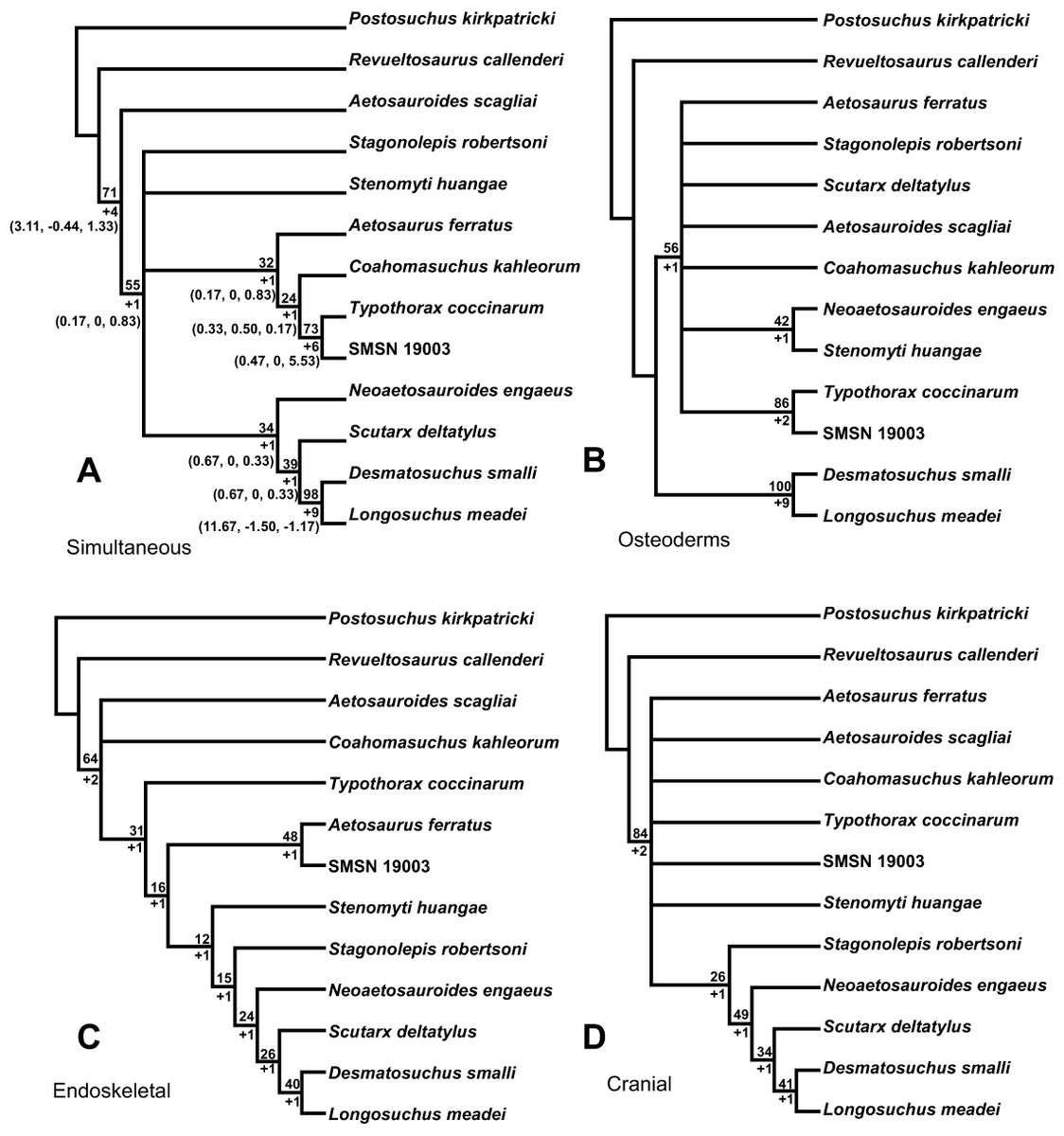
Finally I adapted the method to compute Partioned Bremer Support to look at the possibility of character conflict between anatomical partitions in aetosaurs. Essentially does the armor have a different phylogenetic signal than the rest of the skeleton. Bremer Support is used in all phylogenetic analyses to show branch support; however, what is generally not realized is that the individual support values of characters from each anatomical partition combine to total this number. But if these character sets actually support a different tree than the one recovered in the total character analysis, they will reduce the Bremer Support value (negative Bremer Support). Some character sets are ambivalent and actually provide no support to the branches.  This analytic tool allows you to look at your tree support node by node and see what character datasets support the topology.  This technique has been used since the late 1990s to compare molecular vs. morphological character sets, but this is the first time it has been employed to look at anatomical partitions in a purely morphological study.  


That said, I am a little disappointed with my final discussion section in the paper.  While I am excited about the potential for Partitioned Bremer Support, I still am learning all that it demonstrates, thus my discussion is not as strong as I would have liked. I hope that others will find it of interest and utility and that we can see if if it works for other taxonomic groups. 


Parker, W.G. 2016. Revised phylogenetic analysis of the Aetosauria (Archosauria: Pseudosuchia); assessing the effects of incongruent morphological character sets. PeerJ 4:e1583 https://doi.org/10.7717/peerj.1583

Abstract- Aetosauria is an early-diverging clade of pseudosuchians (crocodile-line archosaurs) that had a global distribution and high species diversity as a key component of various Late Triassic terrestrial faunas. It is one of only two Late Triassic clades of large herbivorous archosaurs, and thus served a critical ecological role. Nonetheless, aetosaur phylogenetic relationships are still poorly understood, owing to an overreliance on osteoderm characters, which are often poorly constructed and suspected to be highly homoplastic. A new phylogenetic analysis of the Aetosauria, comprising 27 taxa and 83 characters, includes more than 40 new characters that focus on better sampling the cranial and endoskeletal regions, and represents the most comprenhensive phylogeny of the clade to date. Parsimony analysis recovered three most parsimonious trees; the strict consensus of these trees finds an Aetosauria that is divided into two main clades: Desmatosuchia, which includes the Desmatosuchinae and the Stagonolepidinae, and Aetosaurinae, which includes the Typothoracinae. As defined Desmatosuchinae now contains Neoaetosauroides engaeus and several taxa that were previously referred to the genus Stagonolepis, and a new clade, Desmatosuchini, is erected for taxa more closely related to Desmatosuchus. Overall support for some clades is still weak, and Partitioned Bremer Support (PBS) is applied for the first time to a strictly morphological dataset demonstrating that this weak support is in part because of conflict in the phylogenetic signals of cranial versus postcranial characters. PBS helps identify homoplasy among characters from various body regions, presumably the result of convergent evolution within discrete anatomical modules. It is likely that at least some of this character conflict results from different body regions evolving at different rates, which may have been under different selective pressures.

Cranial Anatomy of the Aetosaur Paratypothorax andressorum

Schoch, R. R., and J. B. Desojo. 2016. Cranial anatomy of the aetosaur Paratypothorax andressorum Long & Ballew, 1985, from the Upper Triassic of Germany and its bearing on aetosaur phylogeny. Neues Jahrbuch für Geologie und Paläontologie - Abhandlungen 279(1):73-95. DOI: http://dx.doi.org/10.1127/njgpa/2016/0542
http://www.ingentaconnect.com/content/schweiz/njbgeol/2016/00000279/00000001/art00008


Abstract -
The large aetosaur Paratypothorax andressorum has so far been known only by its osteoderms. Here we describe for the first time the skull of a complete, articulated specimen of this taxon that was found in the type horizon at Murrhardt, southwestern Germany. Paratypothorax
andressorum has the following cranial autapomorphies: (1) upper jaw margin with deep notch between premaxilla and maxilla, (2) maxilla-lacrimal suture with finger-like projection, (3) upper
temporal fenestra triangular, and (4) first paramedian cervical osteoderms narrow and oval, much smaller than second row. Apart from these features, the skull of P. andressorum closely resembles that of the small aetosaur Aetosaurus ferratus known from the same horizons, despite major differences in the morphology of osteoderms. Both taxa share (1) the pointed, beak-shaped premaxilla which expands only gently anterior to the nasal, (2) maxilla and lacrimal excluding jugal
from margin of antorbital fenestra, (3) exclusion of squamosal from margin of infratemporal fenestra, and (4) posterior part of jugal not downturned. Phylogenetic analysis reveals poorly resolved relationships within Aetosauria, but exclusion of a problematic taxon Coahomasuchus results in a much better resolution, with Paratypothorax to nest with Rioarribasuchus, Tecovasuchus, Typothorax, and Redondasuchus within a monophyletic Typothoracinae. Interestingly, Aetosaurus and Stenomyti form successive sister taxa of this clade rather than fall within an aetosaurine grade of basal aetosaurs, as suggested by previous authors. The resemblance of Paratypothorax and Aetosaurus in many cranial features, their close relationship as suggested by the present analysis, and the immature state of all available Aetosaurus specimens suggest two new alternative hypotheses: (1) Aetosaurus is the juvenile of a close relative of Paratypothorax or (2) it is itself the juvenile of Paratypothorax.

Bone Histology of Phytosaur, Aetosaur, and Other Archosauriform Osteoderms

Just in time for Christmas...

Scheyer, T. M., Desojo, J. B., and I. A. Cerda. 2013. Bone histology of phytosaur, aetosaur, and other archosauriform osteoderms (Eureptilia, Archosauromorpha). Anatomical Record (early view) DOI: 10.1002/ar.22849

Abstract -
As in other archosauriforms, phytosaurs and aetosaurs are characterized by the presence of well-developed osteoderms. Here we provide a comparative study on the microstructure of phytosaur (five taxa) and aetosaur (thirteen taxa) osteoderms. For outgroup comparison, we sampled osteoderms of the sister taxon to Aetosauria, Revueltosaurus callenderi, and the doswelliid Jaxtasuchus salomoni. Phytosaur, aetosaur, and Jaxtasuchus osteoderms are composed of a diploe structure, whereas the Revueltosaurus osteoderm microanatomy is more compact. The external cortex of phytosaurs, Revueltosaurus and Jaxtasuchus osteoderms is mainly composed of parallel-fibered bone. In aetosaurs, the external cortex mainly consists of lamellar bone, with lines of resorption within the primary bone indicating successive cycles of bone erosion and deposition. The basal cortex in all the specimens is composed of parallel-fibered bone, with the cancellous internal core being more strongly developed in aetosaurs than in phytosaurs. Woven or fibro-lamellar bone was recorded in both phytosaurian and aetosaurian taxa, as well as in Jaxtasuchus. Structural fibers, which at least partly suggest metaplastic origin, were only recorded in the internal core of two phytosaurs and in the
basal cortex of one aetosaur. Osteoderm thickness and cancellous to compact bone ratios appear to be subject to ontogenetic change. Minimum growth mark counts in osteoderms sampled indicate that some aetosaurs and phytosaurs lived for at least two decades. Bone microstructures are more uniform in phytosaur osteoderms and show a higher level of disparity among aetosaur osteoderms, and at least in the latter, histological features are potentially apomorphic for species/genus level.

New Triassic Papers in the Festschift in Honor of Dr. Wann Langston Jr.

Back in very early 2010 Dr. Ernie Lundelius was honored with a festschift volume.  When I congratulated him on it he lamented that his close friend and colleague Dr. Wann Langston Jr., still did not have a festschift in his honor.  Ernie said they had tried to get one going a few times but nothing had ever come of it. I agreed to help to start another one and after several trials am proud to announce that the first online papers are now available from the Earth and Environmental Transactions of the Royal Society of Edinburgh. The final print volume will be out a bit later.  Unfortunately Dr. Langston passed away earlier this year and did not get to see the completed volume; however he did get to see a compilation of the abstracts.

Dr. Langston was Charles L. Camp's graduate student at the University of California at Berkeley and althogh his dissertation was on Permian vertebrates of North America, one of his firs publications was a description of a new phytosaur from the Upper Triassic of Texas.  Thus it is fitting that there are a few Triassic papers in his festschrift volume.  Two, which I was involved with, are up currently: I'll post the rest when they come online.

Parker, W. G. 2013. Redescription and taxonomic status of specimens of Episcoposaurus and Typothorax, the earliest known aetosaurs (Archosauria: Suchia) from the Upper Triassic of western North America, and the problem of proxy “holotypes”. Earth and Environmental Transactions of the Royal Society of Edinburgh First View Article. DOI: http://dx.doi.org/10.1017/S1755691013000212

Abstract - Historic type and referred material of the aetosaurian taxa Typothorax coccinarum, Episcoposaurus horridus and Episcoposaurus haplocerus are redescribed and the non-aetosaurian material identified and removed, a task previously considered “hopeless”. Reexamination of the original material reveals that the holotypes of E. haplocerus and probably T. coccinarum are not diagnosable at the species level and therefore are nomena dubia. The next available names for material referred to these taxa are Desmatosuchus spurensis and E. horridus respectively, although it may be more desirable for reasons of taxonomic stability to attempt to petition for a neotype in the latter case. The redescription of historical specimens is necessary to determine their nomenclatural validity. The use of referred specimens as proxy “type” specimens is problematic, as these referrals were originally made not on the basis of apomorphies, but rather on biostratigraphic and/or geographical assumptions which are inherently circular and cannot be unambiguously supported.

Martz, J. W., Mueller, B., Nesbitt, S. J., Stocker, M. R., Parker, W. G., Atanassov, M., Fraser, N., Weinbaum, J., and J. R. Lehane. 2013. A taxonomic and biostratigraphic re-evaluation of the Post Quarry vertebrate assemblage from the Cooper Canyon Formation (Dockum Group, Upper Triassic) of southern Garza County, western Texas. Earth and Environmental Transactions of the Royal Society of Edinburgh First View Article. DOI: http://dx.doi.org/10.1017/S1755691013000376

Abstract - The Post Quarry, within the lower part of the type section of the Upper Triassic Cooper Canyon Formation in southern Garza County, western Texas, contains a remarkably diverse vertebrate assemblage. The Post Quarry has produced: the small temnospondyl Rileymillerus cosgriffi; the metoposaurid Apachesaurus gregorii; possible dicynodonts and eucynodonts; a clevosaurid sphenodontian; non-archosauriform archosauromorphs (Trilophosaurus dornorum, simiosaurians, and possibly Malerisaurus); the phytosaur Leptosuchus; several aetosaurs (Calyptosuchus wellesi, Typothorax coccinarum, Paratypothorax, and Desmatosuchus smalli); the poposauroid Shuvosaurus inexpectatus (“Chatterjeea elegans”); the rauisuchid Postosuchus kirkpatricki; an early crocodylomorph; several dinosauromorphs (the lagerpetid Dromomeron gregorii, the silesaurid Technosaurus smalli, a herrerasaurid, and an early neotheropod); and several enigmatic small diapsids. Revised lithostratigraphic correlations of the lower Cooper Canyon Formation with the Tecovas Formation, the occurrence of Leptosuchus, and the overall composition of the assemblage indicate that the Post Quarry falls within the Adamanian biozone, and not the Revueltian biozone. Stratigraphic subdivision of the Adamanian biozone may be possible, and the Post Quarry may be correlative with the upper part of the Adamanian biozone in Arizona. The age of the Post Quarry assemblage is possibly late Lacian or earliest Alaunian (late early Norian or earliest middle Norian), between 220 and 215 Ma.


Overview of the Aetosaurs

Desojo, J. B., Heckert, A. B., Martz, J. W., Parker, W. G., Schoch, R. R., Small, B. J., and T. Sulej. 2013. Aetosauria: a clade of armoured pseudosuchians from the Upper Triassic continental beds; From Nesbitt, S. J., Desojo, J. B., and R. B. Irmis (eds.) Anatomy, Phylogeny and Palaeobiology of Early Archosaurs and their Kin, Geological Society Special Publication 379: doi:10.1144/SP379.17

Abstract -
Aetosauria is a clade of obligately quadrupedal, heavily armoured pseudosuchians known from Upper Triassic (late Carnian–Rhaetian) strata on every modern continent except Australia and Antarctica. As many as 22 genera and 26 species ranging from 1 to 6 m in length, and with a body mass ranging from less than 10 to more than 500 kg, are known. Aetosauroides scagliai was recently recovered as the most basal aetosaur, placed outside of Stagonolepididae (the last common ancestor of Desmatosuchus and Aetosaurus). Interrelationships among the basal aetosaurs are not well understood but two clades with relatively apomorphic armour – the spinose Desmatosuchinae and the generally wide-bodied Typothoracisinae – are consistently recognized. Paramedian and lateral osteoderms are often distinctive at the generic level but variation within the carapace is not well understood in many taxa, warranting caution in assigning isolated osteoderms to specific taxa. The aetosaur skull and dentition varies across taxa, and there is increasing evidence that at least some aetosaurs relied on invertebrates and/or small vertebrates as a food source. Histological evidence indicates that, after an initial period of rapid growth, lines of arrested growth (LAGs) are common and later growth was relatively slow. The common and widespread Late Triassic ichnogenus Brachychirotherium probably represents the track of an aetosaur.

Two New Aetosaur Papers Including a New Taxon, Stenomyti huangae, from the Chinle Formation of Colorado

Taborda, J. R. A., Cerda, I. A., and J. B. Desojo. 2013. Growth curve of Aetosauroides scagliai Casamiquela 1960 (Pseudosuchia: Aetosauria) inferred from osteoderm histology. From Nesbitt, S. J., Desojo, J. B., and R. B. Irmis (eds.), Anatomy, Phylogeny and Palaeobiology of Early Archosaurs and their Kin Geological Society Special Publications 379. doi:10.1144/SP379.19

Abstract - Recent palaeohistological studies on paramedian osteoderms of aetosaurs revealed the presence of growth lines (lines of arrested growth or LAGs) and a minimal or nonexistent secondary remodelling in the bone matrix of these elements. This feature allows the age of individuals to be estimated through growth line count. In the present contribution we study the growth curve of the South American aetosaur Aetosauroides scagliai. We estimated the age (obtained from LAG counting) and body size (body length and body mass were used as
proxies) of different aetosaur specimens in order to reconstruct the growth curve of the South American species. The data obtained for Aetosauroides scagliai were compared with that of other aetosaurs, such as Neoaetosauroides engaeus, Aetosaurus ferratus, Aetobarbakinoides brasiliensis, Typothorax coccinarum andParatypothorax sp. Our results indicate that, if body length is considered as proxy, all studied aetosaur specimens have a similar or almost identical growth rate. However, important variations arose among aetosaur taxa if body mass is considered as proxy, which would be related to a body morphology ranging from slender (e.g. Aetobarbakinoides brasiliensis) to very wide (Typothorax coccinarum) morphotypes. In comparison with extant pseudosuchians (i.e. crocodylians), Aetosauroides scagliai possesses a relatively lower growth rate.

Small, B. J., and J. W. Martz. 2013. A new aetosaur from the Upper Triassic Chinle Formation of the Eagle Basin, Colorado, USA.: From Nesbitt, S. J., Desojo, J. B., and R. B. Irmis (eds.), Anatomy, Phylogeny and Palaeobiology of Early Archosaurs and their Kin Geological Society Special Publications 379 doi:10.1144/SP379.18

Abstract - A small aetosaur skull and skeleton and referred material from the Chinle Formation, Eagle Basin of Colorado, USA, is described as a new taxon, Stenomyti huangae gen. et sp. nov, distinguished from other aetosaurs by the following autapomorphies: three premaxillary teeth; four palpebrals; pronounced midline ridge on frontals and parietals; paired ridges flanking midline ridge on parietal and frontal; exclusion of quadratojugal from ventral margin of skull by contact between jugal and quadrate; exclusion of postorbital from infratemporal fenestra; infratemporal fenestra a horizontally oriented oval that embays the posterior edge of the jugal; retroarticular process longer than distance between articular glenoid and posterior edge of external mandibular fenestra; oval to irregularly shaped ventral osteoderms that do not contact each other. Paramedian and lateral osteoderms of S. huangae are nearly identical to those of Aetosaurus ferratus, and other shared cranial characters suggest that
these taxa are closely related and lie outside the clade Typothoracisinae + Desmatosuchinae. This discovery indicates that other reports of Aetosaurus across Laurasia based on osteoderms should be reassessed. Similar confusion with the osteoderms of other non-typothoracisine/desmatosuchine aetosaurs such as Aetosauroides, Stagonolepis and Calyptosuchus suggests that osteoderms are not always reliable taxonomic indicators.


Aetobarbakinoides brasiliensis, a New Aetosaur from the Late Triassic of Brazil

This is an interesting new specimen from the Santa Maria Formation of Brazil. I've had the chance to personally study this material and although poorly preserved and despite possesses a radial patterning of the dorsal osteoderms it clearly does not belong to the South American genera Aetosauroides or Neoaetosauroides mainly because of characteristics of the vertebrae. In fact, the vertebrae with their well developed accessory processes and lack of ventral keels strongly resemble those of desmatosuchines. This is supported by the phylogenetic analysis.

Notably this is the first aetosaur taxon to be diagnosed using postcranial characters rather than those of the osteoderms. Indeed only a few poorly preserved osteoderms are present in the specimen. I've argued in the past that despite the long use of armor ornamentation to diagnose aetosaur species, new specimens are demonstrating that these characters are highly convergent between hypothesized main aetosaur clades and caution must be used.

This paper also finds Aetosaurinae (sensu Parker, 2007) to be paraphyletic. Again this is not surprising given the poor support for the clade in the original analysis, the fact that Aetobarbakinoides possesses "Aetosaurinae"-like armor with desmatosuchine-like vertebrae, and the fact that lateral armor is lacking in this new taxon whereas lateral armor characters strongly affect the topology of Parker (2007). This is not surprising given that the analysis of Parker (2007) was explicitly testing the phylogenetic signal of lateral osteoderms in aetosaurs.

This analysis also recovers Aetosauroides outside of Stagonolepididiae (sensu Heckert and Lucas, 2000), which demonstrates the presence of non-stagonolepidid aetosaurs. Thus the names Stagonolepididae and Aetosauria cannot be used interchangeably (as they commonly are) as I cautioned in 2007.

There is much more work today with the phylogeny of the Aetosauria and many new undescribed specimens.  I am focusing on a lot of these in my ongoing PhD work.

Desojo, J. B., Ezcurra, M. D., and E. E. Kischlat. 2012. A new aetosaur genus (Archosauria: Pseudosuchia) from the early Late Triassic of southern Brazil. Zootaxa 3166:1-33.

Abstract - We describe the new aetosaur Aetobarbakinoides brasiliensis gen. et sp. nov. from the early Late Triassic (late Carnian early Norian) Brazilian Santa Maria Formation. The holotype is composed of a partial postcranium including several cervical and dorsal vertebrae and ribs, one anterior caudal vertebra, right scapula, right humerus, right tibia, partial right pes, and anterior and mid-dorsal paramedian osteoderms. Aetobarbakinoides is differentiated from other aetosaurs by the presence of cervical vertebrae with widely laterally extended prezygapophyses, mid-cervical vertebrae with anterior articular facet width more than 1.2 times wider than the posterior one, anterior caudal vertebrae with extremely anteroposteriorly short prezygapophyses, elongated humerus and tibia in relation to the axial skeleton, and paramedian osteoderms with a weakly raised anterior bar. A cladistic analysis recovered the new species as more derived than the South American genera Aetosauroides (late Carnian-early Norian) and Neoaetosauroides (late Norian-Rhaetian), and it is nested as the sister-taxon of an unnamed clade, composed of Typothoracisinae and Desmatosuchinae, due to the absence of a ventral keel in the cervical vertebrae. Aetobarbakinoides presents a skeletal anatomy previously unknown among South American aetosaurs, with the combination of presacral vertebrae with hyposphene, anteroposteriorly short and unkeeled cervical vertebrae, gracile limbs, and paramedian osteoderms with a weakly raised anterior bar. Aetobarbakinoides is among the oldest known aetosaurs together with Aetosauroides from Argentina and Brazil and Stagonolepis robertsoni from Scotland, indicating Aetobarbakinoides, which is one of the oldest known aetosaurs, is in agreement with an older origin for the group, as it is expected by the extensive ghost lineages at the base of the main pseudosuchian clades.

Aetosaurs Made Brachychirotherium Footprints

Lucas, S. G., and A. B. Heckert. 2011. Late Triassic aetosaurs as the trackmaker of the tetrapod footprint ichnotaxon Brachychirotherium. Ichnos 8: 197-208 DOI:10.1080/10420940.2011.632456

Abstract - Brachychirotherium is the common ichnogenus of Late Triassic chirothere footprints well known from western Europe, North America, Argentina and South Africa. Although it has long been agreed by most workers that the trackmaker of Brachychirotherium was a derived crurotarsan archosaur, the trackmaker has been identified as either a rauisuchian or an aetosaur, and some workers attribute it to a primitive crocodylomorph (sphenosuchian). New knowledge of the osteology of the manus and pes of a large aetosaur, Typothorax coccinarum, indicates a close correspondence between the manus and pes structure of aetosaurs and the morphology of Brachychirotherium. Furthermore, functional analysis of complete skeletons indicates aetosaurs plausibly placed their feet in the narrow gauge, nearly the overstepped walk characteristic of Brachychirotherium. Brachychirotherium and aetosaurs have matched distributions, that is, they were Pangea-wide during the Late Triassic. The manus and pes morphology of rauisuchians and early crocodylomorphs (sphenosuchians) deviate from Brachychirotherium footprint morphology in key features, thus excluding their identification as trackmakers. Aetosaurs made Brachychirotherium footprints.

First Evidence of Aetosaurs from the Plateosaurus Quarry of Germany

Matzke, A. T., and M. W. Maisch. 2011. The first aetosaurid archosaur from the Trossingen Plateosaurus Quarry (Upper Triassic, Germany). Neues Jahrbuch für Geologie und Paläontologie – Abhandlungen (advance online publication) DOI: 10.1127/0077-7749/2011/0203http://www.ingentaconnect.com/content/schweiz/njbgeol/pre-prints/0203

Abstract -Two associated cervical paramedian osteoderms and one isolated paramedian osteoderm of an aetosaur from the famous Trossingen Plateosaurus Quarry are described. They represent the first evidence of aetosaurs from Trossingen as well as the stratigraphically youngest remains of this group from Germany. Therefore, the Trossingen assemblage consists now of four species level taxa. Hitherto only three species level taxa were known from this quarry. Plateosaurus longiceps and Proganochelys quenstedti from complete specimens as well as one tooth of cf. Liliensternus. The finds indicate that more small- to medium-sized taxa may be present in the Trossingen Quarry.

The Aetosaurus Block

After a crazy spring things are pretty slow in the Triassic right now, with hardly any new papers coming out in recent weeks.  Even our fieldwork has pretty much ground to a halt given the recent extreme heat in the western U.S. Plus, I'm taking a week off from work, so things will be even slower; however, I'm expecting things to take off again pretty soon. 

In the meantime here is a shot showing the famous block of Aetosaurus ferratus specimens from the Lower Stubensanstein of Germany.


a close-up of one of the best preserved skulls


and an older reconstruction (from Wikipedia) showing several Aetosaurus perishing in a sandstorm.


These specimens (collected and first described in the 1800s) were the subject of an excellent detailed description by Rainer Schoch in 2007.

REFERENCE

Schoch, R. R. 2007. Osteology of the small archosaur Aetosaurus from the Upper Triassic of Germany. N. Jb. Geol. Paläont. Abh. 246:1– 35

"Belodon" from Creatures of Other Days by Hutchinson and Flower (1894)

Is everyone still here? ;) This is an early reconstruction of the phytosaur "Belodon" by artist Joseph Smit who provided many of the illustrations for Creatures of Other Days. Interestingly the skull is based on what is now called Nicrosaurus kapffi and the dorsal carapace is actually from the aetosaur Paratypothorax andressorum. The idea that some phytosaurs possessed aetosaur-like osteoderms was to plague the  taxonomy of these two groups until the work of Long and Ballew (1985) who named Paratypothorax and assigned all of these type of osteoderms to aetosaurs. Interestingly, this reassignment was done using existing specimens only. No 'rosetta stone' specimen was found (i.e., the skull of Paratypothorax) to support this referral. However, subsequent discoveries have verified Long and Ballew's hypothesis.

The small animals in the reconstruction are the aetosaur Aetosaurus. The one of the left seems to be wondering why the phytosaur is wearing aetosaur armor.

The South American Aetosaur Aetosauroides is Not Referable to Stagonolepis

In a series of papers Heckert and Lucas (1999, 2000, 2002) and Lucas and Heckert (2001) proposed that the American aetosaur taxon Aetosauroides was a junior synonym of Stagonolepis, and that as a result the Ischigualasto (Argentina) and the Santa Maria (Brazil) formations were Adamanian (latest Carnian) in age based upon vertebrate biostratigraphy and correlable with other Adamanian strata such as the lower part of the Chinle Formation in western North America. However, these synonomies were based on very superficial resemblances and not on apomorphy based comparisons (Parker, 2008).

The new issue of the Journal of Vertebrate Paleontology has a paper by Julia Desojo and Martin Ezcurra redescribing some of the Aetosauroides material and refuting the synonomy with Stagonolepis using a detailed comparison of characters. Especially important are characters of the skull, which clearly demonstrates strong differences between the two taxa.

As a result Stagonolepis is not known from South America and therefore the proposed biostratigraphic correlations between South America, North America, and Europe using aetosaurs is not supported by this study. This is also supported by radiometric dates which show a 10 million year difference between the main fossil horizon in ht eIschigualasto Formation and the base of the main fossil bearing beds in the Chinle Formation (Irmis and Mundil, 2008).

I have suggested elsewhere (Parker, 2008) that Stagonolepis does not occur in North America either and thus aetosaur taxa appear much more endemic than argued by Heckert and Lucas and thus of limited (only regional) biostratigraphic utility.

Biostratigraphy and taxonomy aside, this redescription highlights the plesiomorphic nature of Aetosauroides, especially regarding features of the skull including a gracile, fully-toothed dentary, different from the "slipper-shaped", anteriorly edentulous mandibles of more derived aetosaurs, and the meeting of the premaxilla and nasal to exclude the maxilla from the margin of the external naris. Thus, Aetosauroides is an interesting and clearly plesiomorphic form with an armor ornamentation convergent with more derived forms such as Stagonolepis and Calyptosuchus.

Desojo, J. B., and M. D. Ezcurra. 2011. A reappraisal of the taxonomic status of Aetosauroides (Archosauria, Aetosauria) specimens from the Late Triassic of South America and their proposed synonymy with Stagonolepis. Journal of Vertebrate Paleontology 31:596-609. DOI: 10.1080/02724634.2011.572936

Abstract - The South American record of early Late Triassic aetosaurs is composed of two species: Aetosauroides scagliai and “Aetosauroides subsulcatus.” Previously undescribed materials belonging to “Aetosauroides subsulcatus” allow us to reassess its taxonomy, leading us to consider it a junior synonym of Aetosauroides scagliai. Based on the emended diagnosis of the species provided here, we recognize that specimens assignable to Aetosauroides scagliai are less common than thought previously and several of them are not diagnostic beyond indeterminate non-typothorasicine aetosaurins. Previous assignments of Aetosauroides as a junior synonym of Stagonolepis are not followed because the South American taxon is distinct due to the presence of a maxilla excluded from the external narial margin, tooth crowns with a straight distal margin and without a constriction between the root and crown, a gradually convex ventral margin of the dentary, oval fossae ventral to the neurocentral suture on the lateral sides of the centra, and a ratio between the length and the width between the distal-most tips of the postzygapophyses equal to or lower than 0.75. The evidence provided here bolsters the validity of Aetosauroides and extends the distribution of Aetosauroides scagliai into southern Brazil. Although Stagonolepis was employed as an index taxon for the Adamanian LVF, this genus is currently restricted to Europe and North America. Thus, no overlapping genera or species of aetosaur are shared between South America and other landmasses. Accordingly, the record of aetosaurs is not useful for providing biostratigraphical correlations between Late Triassic South American beds and those in other regions.

REFERENCES

Heckert, A. B., and S. G. Lucas. 1999. A new aetosaur from the Upper Triassic of Texas and the phylogeny of aetosaurs. Journal of Vertebrate Paleontology 19:50–68.

Heckert, A. B., and S. G. Lucas. 2000. Taxonomy, phylogeny, biostratigraphy, biochronology, paleobiogeography, and evolution of the Late Triassic Aetosauria (Archosauria: Crurotarsi). Zentralblatt fur Geologie und Palaontologie, 1998, Teil I, Heft 11–12:1539–1587.

Heckert, A. B., and S. G. Lucas. 2002. South American occurrences of the Adamanian (Late Triassic, Latest Carnian) index taxon Stagonolepis (Archosauria: Aetosauria) and their biochronological significance. Journal of Paleontology 76:852–863.

Irmis, R. B., and R. Mundil. 2008. New age constraints from the Chinle Formation revise global comparisons of Late Triassic vertebrate assemblages. Journal of Vertebrate Paleontology 28:95A.

Lucas, S. G., and A. B. Heckert. 2001. The aetosaur Stagonolepis from the Upper Triassic of Brazil and its biochronological significance. Neues Jahrebuch fur Geologie und Palaontologie, Monatshefte 2001:719–732.
Parker, W. G. 2008. How many valid aetosaur taxa are there? Reviewing the alpha-taxonomy of the Aetosauria (Archosauria: Pseudosuchia) and its implications for Late Triassic global biostratigraphy. Journal of Vertebrate Paleontology 28:125A.

Rioarribasuchus chamaensis Reconstruction

Here is Jeff Martz's recent reconstruction of the aetosaur Rioarribasuchus chamaensis.

His reconstruction is a little different than the one in my 2007 paper. He felt that in the original reconstruction I had the paramedian plates with the pronounced spines too far forward and after much discussion I concur. 

I think that this new reconstruction is probably fairly accurate given what we know about Rioarribasuchus and other paratypothoracisin aetosaurs, and it contrasts strongly from other reconstructions that still portray it as a Desmatosuchus-like aetosaur. This relationship was refuted by phylogenetic analysis, and although I really like Matt Celeskey's artwork, the reconstruction as a desmatosuchine is not based upon any actually recovered fossil material. All of the osteoderms with spines in the Rioarribasuchus type material are paramedian plates from the caudal region and nothing homologous with the cervical lateral spines in Desmatosuchus are known.

REFERENCE

Parker, W. G. 2007. Reassessment of the Aetosaur 'Desmatosuchus' chamaensis with a

reanalysis of the phylogeny of the Aetosauria (Archosauria: Pseudosuchia). Journal of Systematic Palaeontology 5:41-68. DOI: 10.1017/S1477201906001994

An Upclose Look at the Microanatomy of Aetosaur Osteoderms

Aetosaurs are characterized by their elaborate bony carapaces composed of numerous osteoderms.  In fact aetosaur taxonomy is almost based solely on the morphology (especially the surface ornamentation) of osteoderms.  Despite this detailed studies of the microstructure of aetosaur oseoderms are lacking.  In 2008 I published a paper with Michelle Stocker and Randall Irmis that provided the first histological data for aetosaur osteoderms, but we were mostly looking at providing an estimated age at time of death for the holotype of Sierritasuchus macalpini to determine the ontogenetic stage of the specimen.

This new study focuses on aetosaurine osteoderms from Argentina and Brazil, including specimens assigned to Aetosauroides scagliai. One of the very cool things these authors did was not only to look a parasaggital sections of the rectangular osteoderms, they also looked at transverse sections. Some of the key findings are as follows:

- Aetosaur osteoderms lend themselves well to this type of study as secondary remodeling is minimal.

-Unlike all other sampled archosaurs, aetosaur osteoderm ossification was not metaplastic in nature (i.e. pre-existing, fully developed tissue is ossified), instead the osteoderms seemingly underwent intermembraneous ossification where new tissue displaces preformed tissue rather than incorporating it.  This is currently unique among archosaurs.

- Cyclic growth lines (Lines of arrested growth of LAG's) are well developed. Based on this the specimens sampled belonged to a range of subadult animals between two and nine years of age at time of death (minimum ages).

- The center of ossification in aetosaur osteoderms is at the level of the raised dorsal eminence.

- Aetosaur plates probably grew by adding peripheral layers.  Interestingly most faster growth occurred along the medial and lateral margins.  This accounts for the assymetrical placement of the dorsal eminence that is characteristic of aetosaurines.

- Well-developed Sharpey's fibers along the medial and lateral margins of the osteoderms suggest strong lateral and medial attachments along a row of osteoderms.  In contrast the attachments with anterior of posterior plates were poor, presumably allowing for flexion and movement in the carapace.

-Finally, the ornamentation of the osteoderms is formed by local resorption and partitial redeposition of the cortical bone. Acceleration of growth in particular areas enhances the degree of sculpture through time and the pattern is established early and then maintained through future growth.  This is seemingly why the ornamentation in juvenile specimens does not differ significantly from that of adults. This is extremely significant if you are using this patterning to diagnose taxa.

Overall an important study and excellent paper.

Cerda, I. A., and J. B. Desojo. 2010: Dermal armour histology of aetosaurs (Archosauria: Pseudosuchia), from the Upper Triassic of Argentina and Brazil. Lethaia, DOI: 10.1111/j.1502-3931.2010.00252.x.


Abstract - One of the most striking features documented in aetosaurs is the presence of an extensive bony armour composed of several osteoderms. Here, we analyse the bone microstructure of these elements in some South American Aetosaurinae aetosaurs, including Aetosauroides scagliai. In general terms, Aetosaurinae osteoderms are compact structures characterized by the presence of three tissue types: a basal cortex of poorly vascularized parallel-fibred bone tissue, a core of highly vascularized fibro-lamellar bone, and an external cortex of rather avascular lamellar bone tissue. Sharpey’s fibres are more visible at the internal core, toward the lateral margins and aligned parallel to the major axis of the dermal plate. No evidence of metaplastic origin is reported in the osteoderms, and we hypothesize an intramembranous ossification for these elements. The bone tissue distribution reveals that the development of the osteoderm in Aetosaurinae starts in a position located medial to the plate midpoint, and the main sites of active osteogenesis occur towards the lateral and medial edges of the plate. The osteoderm ornamentation is originated and maintained by a process of resorption and redeposition of the external cortex, which also includes preferential bone deposition in some particular sites. Given that no secondary reconstruction occurs in the osteoderms, growth marks are well preserved and they provide very important information regarding the relative age and growth pattern of Aetosaurinae aetosaurs.

Time Now for a Pseudosuchian - Desmatosuchus spurensis by Jeff Martz

Based on the traffic I've been getting everyone has really been enjoying the critter reconstructions by Jeff Martz. The past few days have focused on the ornithidirans but I think it is time to journey over to the other archosaurian branch.  Here is the aetosaur Desmatosuchus spurensis from the Late Triassic of the American southwest. If you really enjoy Jeff's work, please let him hear it.

The Importance in Understanding Historical Context in Solving Taxonomic Problems - A Case Study With Aetosaurs

Parker, W. G. and Martz, J. W. 2010. Using positional homology in aetosaur (Archosauria: Pseudosuchia) osteoderms to evaluate the taxonomic status of Lucasuchus hunti, Journal of Vertebrate Paleontology 30:1100-1108.

Abstract - The Otis Chalk quarries in the Upper Triassic Dockum Group of West Texas have produced aetosaur material that most workers have suggested represents two distinct morphotypes. We use characters from aetosaur specimens with articulated or semi-articulated carapaces in which the anteroposterior placement of osteoderms can be established with certainty to compare homologous osteoderms in the Otis Chalk material. This study confirms that the genera Longosuchus and Lucasuchus are distinct morphotypes, which differ in that the former taxon has paramedian osteoderms with random pitted ornamentation and low pyramidal bosses that contact the posterior margin, and spines on the lateral osteoderms that are posteriorly emarginated, whereas the latter taxon has paramedians with a strongly radial ornamentation and large conical eminences, and spines on the lateral osteoderms that are not posteriorly emarginated. Both taxa also have paramedians that are overlapped anteriorly by the laterals, a character that may be a synapomorphy of desmatosuchine aetosaurs. The arguments that these morphotypes represent ontogenetic stages or sexual dimorphs of a single biological species cannot be corroborated using either comparisons with modern pseudosuchians, other aetosaur taxa, or stratigraphic ranges. Longosuchus is known only from the type area and has no utility as an index taxon of the Otischalkian land-vertebrate faunachron, although Lucasuchus suggests a tentative correlation between part of the Dockum Group of Texas and the Pekin Formation of North Carolina.

Discussion

Study and management of any resource, including vertebrate fossils, requires in-depth understanding of the context under which previous work on these materials was conducted. For example, where, how, and by whom were the specimens collected? What was their original association? How were they prepared? Who identified them and why did they apply the identification that they did? Often in vertebrate paleontology we are faced with taxonomic questions, which to answer properly we need this detailed contextural information. A good example of this in aetosaurs (the group I mainly work with) is the ongoing debate regarding the proposed synonymy of Longosuchus meadei and Lucasuchus hunti. Much confusion exists regarding the specimens assigned to these taxa, much which stems from the original collection, as well as the subsequent curation and description of these materials. Recently I, along with my co-author Jeffrey Martz, tried to tackle this taxonomic problem and our resulting paper was just published in the most recent issue of the Journal of Vertebrate Paleontology. This article necessitated discussion of the history of the collection, study, and curation of these specimens and unfortunately some of the information I now have did not make it into the final article. At the time this article was in press I came across more important information on the collection and study of these specimens and unfortunately it was too late to add to the introductory section. Some of this new information (from quarry reports and correspondence), included here, clarifies or corrects introductory statements made in our paper.

In the late 1930s and early 1940s a paleontology inventory of portions of Texas was conducted under the Works Progress Administration (WPA), a relief program established by the U.S. Government to put millions of unemployed American men to work. Extensive quarrying was conducted at several sites in Texas including a series of Late Triassic age quarries near Otis Chalk in Howard County. These quarries contained thousands of bones of metoposaurs, phytosaurs, aetosaurs, etc., and are especially known for the well preserved skeletons of the archosauromorph Trilophosaurus buettneri (Gregory, 1945; Elder, 1978; Spielmann et al, 2008). Quarries 3 and 3A contained the majority of the aetosaur material including several partial to fairly complete aetosaur skeletons, only some of which has been prepared. The “best” two skeletons; however, were prepared and subject to a full description by Sawin (1947). Specimen lists compiled at the time of collection as well as work reports reveal that all of the aetosaur material was assigned to the genus Desmatosuchus at the time of collection. Many of the specimens still contain field numbers, which include the county name, quarry number, the year collected, and a fourth number that represents the order in which the specimen was removed from the ground and documented. Furthermore, collection records sometimes provide the name of the collector. Unfortunately, this number just reflects the collection order and often can be ambiguous about the association of specimens in the ground. In our paper we state that no excavation records could be found, but specimen lists and reports have since come to light although no detailed quarry maps are still known to exist.

Workers prepared the two associated skeletons, as well as the articulated tail of a third individual, and a variety of isolated elements. In the final publication (Sawin, 1947) the majority of these specimens are assigned to a new species, Typothorax meadei, based mainly on the sigmoidal shape of the femur (Sawin, 1947). Sawin also recognized a second species, T. coccinarum, as present in the quarry, but restricted this assignment to several osteoderms with large conical dorsal eminences, which he thought resembled the conical eminences in T. coccinarum osteoderms figured and described by von Huene (1915) and originally studied by Cope in 1887. Sawin (1947) designated the two main skeletons (Typothorax meadei) as syntypes and one of the specimens (TMM 31185-84a) was partially incorporated into a museum mount (some of the armor as well as the limbs) along with the articulated tail of the third individual. Much of the remaining material was left identified and catalogued in the collections as Desmatosuchus (contra Parker and Martz, 2010), including many lateral plates which were superficially similar to those of T. meadei. What is important is that none of this material is actually referable to Desmatosuchus (Parker and Martz, 2010).

In an unpublished M.S. thesis Elder (1978) noted this similarity and argued that Desmatosuchus and Typothorax were therefore synonymous. This was later refuted by Small (1989), but what is important to note is that like Sawin, Elder recognized two distinct morphologies in the Otis Chalk material.

Later recognition of the utility of osteoderms ornamentation in aetosaur taxonomy by Long and Ballew (1985) led those workers as well as others (e.g., Small, 1989) to recognize that T. meadei represented a distinct genus from T. coccinarum. Hunt and Lucas (1990) accordingly supplied the name Longosuchus meadei. Curiously, in their renaming of the material and designation of a lectotype Hunt and Lucas (1990) also included the material that Sawin (1947) had assigned to T. coccinarum. Unfortunately, no explanation is given for this and from the article it is not clear if Hunt and Lucas (1990) recognized that some of the material had originally been assigned to a different taxon. They also provide no discussion of the material referred to Desmatosuchus, but infer in their biochronology section that all of the Otis Chalk material belongs to a single taxon.

Subsequent re-examination of the material by Long and Murry (1995) led to the separation of Sawin’s (1947) “T. coccinarum” material as well as the “Desmatosuchus” material from the original T. meadei material of Sawin. Long and Murry (1995) assigned these specimens to a new taxon, Lucasuchus hunti (presumably in return for the name Longosuchus, named for Long). This reassigned was criticized, particularly by Heckert and Lucas (1999, 2000; and in numerous subsequent papers) and Lucas and Heckert (1996) who all stated that the diagnosis of Lucasuchus is “based on minor differences in scute morphology, some so subjective they cannot be replicated”. They also stated that Long and Murry (1995) “split” Longosuchus; however, this is incorrect as they only recognized the originally division of the material set forth by Sawin (1947).

In my own initial examination of the material (Parker, 2003) I felt that there actually were pretty clear differences between the holotype osteoderms of Lucasuchus and Longosuchus, especially in the paramedian osteoderm ornamentation and in the position of the dorsal eminence (see Parker and Martz, 2010). Moreover, although superficially similar there were also key differences between the lateral osteoderms of L. meadei and those catalogued as “Desmatosuchus” and assigned to Lucasuchus by Long and Murry (1995). What was ambiguous; however, was the association of these lateral osteoderms with the Lucasuchus paramedian osteoderms. Although Sawin (1947) felt that there were two morphotypes represented by the paramedian osteoderms in the collections, he clearly stated that no lateral osteoderms were associated with his “T. coccinarum” (Lucasuchus) material.

This last puzzle was solved unintentionally by Ron Tykoski, who while working for the Texas Memorial Museum (TMM) made a small collection of osteoderms to place around the base of the mount. One of the osteoderms he selected was a paramedian of Lucasuchus (TMM 31100-66) and nearby was a lateral osteoderm with the same number. Amazingly these two osteoderms fit together perfectly and unambiguously to form a conjoined pair, and thus must have come from the same individual. Even better, this lateral was of the Lucasuchus morphology and not from Longosuchus. Finally we were able to compare homologous series from both morphotypes to strongly (we feel) demonstrate support for Long and Murry’s (1995) reseparation of the material into two distinct taxa. This was the basis for the entire paper by Parker and Martz (2010).

One final puzzle (at least for me) was why Sawin had assigned the material to Typothorax in the first place? This is where knowledge of the historical context is crucial. At the time the material was collected (1939-1940) there were only three aetosaur taxa known from western North America, Typothorax, Episcoposaurus, and Desmatosuchus. By the time Sawin conducted his study it had been hypothesized by many workers that Episcoposaurus and Desmatosuchus were congeneric, something that was finalized later by Gregory (1953). This was based mainly on the material of Episcoposaurus haplocerus; however, another referred species E. horridus, had been collected in the same general area as the holotype and referred material of Typothorax coccinarum. Personal correspondence between Dr. John Wilson of the TMM and Dr. E. C. Case of the University of Michigan written in the 1940s clarify that Sawin travelled to the American Museum of Natural History to examine Cope’s material of E. horridus and T. coccinarum. This material, figured by Lucas et al (2007) contains two distinct femur morphologies. A gigantic straight femur was referred (by Cope) to E. horridus, whereas a much more gracile and strongly sigmoidal femur was assigned to T. coccinarum. The femora of Longosuchus meadei are nearly identical to that of the referred T. coccinarum specimens contra the statement by Heckert et al. (2010:637) that they are “dramatically different”. It was also on this visit that Sawin noted the conical eminences in the caudal osteoderms of T. coccinarum that formed the basis of his assignment of the Lucasuchus material to that taxon. Thus, finding the Wilson-Case correspondence solves the last part of the puzzle.

I hope that this case provides a good example of how essential understanding the context of the specimens on hand are when we try to determine aspects such as original association, curation, and taxonomy. With this information we can now understand why certain taxonomic assignments were made by past researchers. Allowing ourselves the opportunity to “walk in their boots” of our predecessors for awhile is an important tool in solving important scientific problems.


Paramedian osteoderms of Longosuchus meadei

Paramedian osteoderm of Lucasuchus hunti. Note strong radial patterning and prominent, centralized raised eminence.

REFERENCES

Elder, R. L. 1978. Paleontology and paleoecology of the Dockum Group, Upper Triassic, Howard County, Texas. M.S. thesis, University of Texas, Austin, Texas, 205 pp.

Gregory, J. T. 1945. Osteology and relationships of Trilophosaurus. University of Texas Publication 4401: 273-359.
Gregory, J. T. 1953. Typothorax and Desmatosuchus. Postilla 16:1–27.

Heckert, A. B., and S. G. Lucas. 1999. A new aetosaur (Reptilia: Archosauria) from the Upper Triassic of Texas and the phylogeny of aetosaurs. Journal of Vertebrate Paleontology 19:50–68.

Heckert, A. B., and S. G. Lucas. 2000. Taxonomy, phylogeny, biostratigraphy, biochronology, paleobiogeography, and evolution of the Late

Triassic Aetosauria (Archosauria: Crurotarsi). Zentralblatt für Geologie und Paläontologie, Teil I, Heft 11–12:1539–1587.

Heckert, A. B. , Lucas, S. G. , Rinehart, L. F. , Celeskey, M. D. , Spielmann, J. A. and Hunt, A. P. 2010. Articulated skeletons of the aetosaur Typothorax coccinarum Cope (Archosauria: Stagonolepididae) from the Upper Triassic Bull Canyon Formation (Revueltian: early-mid Norian), eastern New Mexico, USA. Journal of Vertebrate Paleontology 30:619 — 642

Huene, F. v. 1915. On reptiles of the New Mexican Trias in the Cope collection. Bulletin of the American Museum of Natural History 34:485–507.

Hunt, A. P., and S. G. Lucas. 1990. Re-evaluation of “Typothoraxmeadei, a Late Triassic aetosaur from the United States. Paläontologische Zeitschrift 64:317–328.

Long, R. A., and K. L. Ballew. 1985. Aetosaur dermal armor from the Late Triassic of southwestern North America, with special reference to material from the Chinle Formation of Petrified Forest National Park. Museum of Northern Arizona Bulletin 54:45–68.

Long, R. A., and P. A. Murry. 1995. Late Triassic (Carnian and Norian) tetrapods from the Southwestern United States. New Mexico Museum of Natural History and Science Bulletin 4:1–254.

Lucas, S. G., and A. B. Heckert. 1996. Late Triassic aetosaur biochronology. Albertiana 17:57–64.

Lucas, S. G., J. A. Spielmann, A. B. Heckert, and A. P. Hunt. 2007. Topotypes of Typothorax coccinarum, a Late Triassic aetosaur from the American Southwest. New Mexico Museum of Natural History and Science Bulletin 41:241–247.

Parker, W. G. 2003. Description of a new specimen of Desmatosuchus haplocerus from the Late Triassic of Northern Arizona. M.S. thesis, Northern Arizona University, Flagstaff, 315 pp.

Sawin, H. J. 1947. The pseudosuchian reptile Typothorax meadei. Journal of Paleontology 21:201–238.

Small, B. J. 1989. Aetosaurs from the Upper Triassic Dockum Formation, Post Quarry,West Texas; pp. 301–308 in S. G. Lucas and A. P. Hunt (eds.), Dawn of the Age of Dinosaurs in the American Southwest. New Mexico Museum of Natural History, Albuquerque, New Mexico.

Spielmann, J. A., Lucas, S. G., Rinehart, L. F. and A. B. Heckert. 2008. The Late Triassic archosauromorph Trilophosaurus. New Mexico Museum of Natural History and Science Bulletin 43: 1–177.

Typothorax in the New Issue of JVP

Heckert, A. B., Lucas, S. G., Rinehart, L. F., Celeskey, M. D., Justin A. Spielmann, J. A., and A. P. Hunt. 2010. Articulated skeletons of the aetosaur Typothorax coccinarum Cope (Archosauria: Stagonolepididae) from the Upper Triassic Bull Canyon Formation (Revueltian: Early-Mid Norian), Eastern New Mexico, USA. Journal of Vertebrate Paleontology 30:619-642.


Abstract - We report two nearly complete, articulated skeletons of the crurotarsan archosaur Typothorax coccinarum from the Upper Triassic Bull Canyon Formation of east-central New Mexico. These are the most complete, articulated aetosaurs from North America and provide a wealth of new anatomical and paleobiological data, including articulated presacral armor that confirms the distinctiveness of T. coccinarum from the closely related T. antiquum and from Redondasuchus. Cervical vertebrae are small, but the corresponding reduction in armor is accomplished by a reduced number of cervical osteoderms. The third row of osteoderms includes a thin, elongate, lateral spike. The ventral armor consists of 10 thoracic columns and four caudal columns of osteoderms. Spiked osteoderms near the cloacal vent are the first spikes reported in aetosaurian ventral osteoderms. The forelimb of T. coccinarum was very short, only ∼0.65 the length of the hind limb, possesses some adaptations found in digging taxa, and was held in a sprawling or ‘semi-erect’ position. In contrast the hind limb is much more robust, ‘pillar erect,’ and functionally mesotarsal. The articulated pes, including unguals, has, minimally, the phalangeal formula 2-3-3?-4?-3? with relative digit lengths III > II > IV > I > V, digits I–IV equally as wide as long and other characteristics of the footprint ichnogenus Brachychirotherium, often attributed to an aetosaurian trackmaker. Both specimens are ∼2.5 m long and the preserved armor and limb bones are as large or larger than known Typothorax fossils, suggesting that this approximates the upper size limit of T. coccinarum, and we calculate body mass estimates of ∼100–104 kg for both specimens.

There is Only One Way to Study an Aetosaur.....

and that is to lay them out.

This is Texas Memorial Museum (TMM) specimen 31185-84B, the lectotype of Longosuchus meadei from the Dockum Group of Texas.

Beautiful New Aetosaur Skull Material of Stagonolepis from Poland

This is absolutely beautiful material, which allows for a detailed description of the skull of the European genus Stagonolepis.  Sulej differentiates this material as a new taxon, S. olenkae.  This material is believed to from an equivalent of the Lehrberg beds of Germany, thus from the Middle Keuper (Carnian).  Thus it is older than material from the Southwest U. S. (Calyptosuchus wellesi) that has often been assigned to Stagonolepis on the basis on radial armor patterning. The same quarry that produced these skulls provided the holotype material of the non-dinosaurian dinosauriform Silesaurus opolensis. Be advised that the evolutionary hypothesis presented here for aetosaurs is based on hypothetical stratigraphic position (which can not be precisely determined globally) and not a phylogenetic analysis. However, although I don't agree with all of the details of this paper, the specimen is perfectly preserved and provides lots of new information, especially the skull roof and braincase shown below.


Sulej, T. 2010. The skull of an early Late Triassic aetosaur and the evolution of the stagonolepidid archosaurian reptiles. Zoological Journal of the Linnaean Society 158, 860–881.

Abstract - Disarticulated bones of several individuals recovered from the Late Triassic fluvial and lacustrine deposits at Krasiejów, Poland, are here described, allowing the restoration of the skull structure of a new aetosaurian archosaur: Stagonolepis olenkae sp. nov. The Krasiejów deposits probably correspond in age to the Lehrberg Beds (late Carnian) of Baden-Württemberg, Germany. The stratigraphical position of the new taxon combined with other available evidence is used to propose a model of aetosaurian evolution. The proposed phylogenetic position of Aetosaurus ferratus (Norian, Germany) as the basal aetosaurid is refuted and this species is instead proposed to be the most derived member of the Stagonolepis–Aetosaurus evolutionary lineage. Gradual change in several morphological characters can be observed from Stagonolepis robertsoni, through the new species from Krasiejów, to the stratigraphically youngest Aetosaurus ferratus. These changes include a decrease in the number of teeth and a decrease in the convexity of the ventral profile of the maxilla. The anterior elongation of the maxilla is associated with the expansion of the anterior tip of the maxilla towards the naris. In S. robertsoni and S. olenkae, the maxilla extends to middle of the naris, whereas in Aetosaurus, it reaches the anterior half of the naris.

Finally! Aetosaurs in National Geographic Magazine

The most recent issue of National Geographic has an article titled 'When Crocs Ruled' which mainly focuses on the long evolutionary history of the crocodile lineage and the threats extant crocodylians face today. One highlight of the article is the large two page spread of the Desmatosuchus mount from Petrified Forest National Park. It's a nice photo that almost makes me forget about the erroneous armor reconstruction (Unfortuntely, we'll need to remold and cast the whole thing to fix). I'm not as forgiving with the term "croc forerunner" in the title, because as we know aetosaurs were never crocodiles and their lineage did not give rise to the group. Still, I'm thrilled to see an aetosaur displayed prominently in National Geographic (but why not the cover?)

There is also a time line with some great reconstructions that gives props to Triassic forms such as Effigia, Postosuchus, and Proterosuchus. It also gives a good representation of crocodylomorph diversification through the later Mesozoic and Tertiary, something that often gets overshadowed by the dinosaurs, birds, and mammals.

There is also a secondary article by Paul Sereno titled "Strange Crocs of the Sahara", which again tries to demonstrate the great diversity in forms. Although I don't really care for terms such as 'RatCroc', 'DogCroc', and 'DuckCroc' they do seem to get the point across.