Wang, W., Li, C., Scheyer, T. M., and Zhao, L. 2019. A new species of Cyamodus (Placodontia, Sauropterygia) from the early Late Triassic of south-west China. Journal of Systematic Palaeontology. Link.
Abstract - The Triassic eastern Tethyan faunas have continued to yield numerous specimens of marine reptile taxa in recent years. Nevertheless, compared with other sauropterygian clades, the diversity of placodonts in these faunas is low, and remains of this group are relatively rare in the fossil assemblages. Here, we report a new cyamodontoid specimen (ZMNH M8820) from the early Late Triassic of Guizhou, south-west China. This specimen is a nearly complete skeleton lacking only the forelimbs. It is distinct from other known Chinese placodonts as it features a large skull with remarkably enlarged supratemporal fenestrae and a small and less regularly arranged carapace. Interestingly, this new specimen resembles the European Cyamodus more than any Chinese cyamodontoid genera, particularly when considering the dentition and other cranial morphology. However, it differs from known Cyamodus species in some cranial features (e.g. epipterygoid fully ossified, posttemporal fenestra large, dentition derived) and the absence of a separate pelvic shield. Furthermore, based on an updated data matrix of placodonts, our phylogenetic results support the affinity of this new Chinese specimen with European Cyamodus species, and a new species, Cyamodus orientalis sp. nov., is erected here. This new material represents the first reported Cyamodus specimen in the world that preserves a three-dimensional skull with an associated postcranial skeleton and it extends the distribution of this genus into the early Carnian of the eastern Tethys. The existence of Cyamodus, a nearshore taxon, in south-west China at this time reveals greater similarity and more rapid intercommunication than previously known between western and eastern Tethyan vertebrate faunas, although the palaeobiogeographical origin and migration history of Cyamodontidae – and of other clades of placodont reptiles – are still obscure due to the scarcity of material from the northern and southern margins of the Palaeotethys.
Showing posts with label China. Show all posts
Showing posts with label China. Show all posts
Platypus-like Hupehsuchian from Early Triassic of China

Cheng, L., Motani, R., Jiang, D., Yan, C., Tintori, A. and O. Rieppel. 2019. Early Triassic marine reptile representing the oldest record of unusually small eyes in reptiles indicating non-visual prey detection. Scientific Reports 9, number 152. DOI: 10.1038/s41598-018-37754-6
Abstract - The end-Permian mass extinction (EPME) led to reorganization of marine predatory communities, through introduction of air-breathing top predators, such as marine reptiles. We report two new specimens of one such marine reptile, Eretmorhipis carrolldongi, from the Lower Triassic of Hubei, China, revealing superficial convergence with the modern duckbilled platypus (Ornithorhynchus anatinus), a monotreme mammal. Apparent similarities include exceptionally small eyes relative to the body, snout ending with crura with a large internasal space, housing a bone reminiscent of os paradoxum, a mysterious bone of platypus, and external grooves along the crura. The specimens also have a rigid body with triangular bony blades protruding from the back. The small eyes likely played reduced roles during foraging in this animal, as with extant amniotes (group containing mammals and reptiles) with similarly small eyes. Mechanoreceptors on the bill of the animal were probably used for prey detection instead. The specimens represent the oldest record of amniotes with extremely reduced visual capacity, utilizing non-visual cues for prey detection. The discovery reveals that the ecological diversity of marine predators was already high in the late Early Triassic, and challenges the traditional view that the ecological diversification of marine reptiles was delayed following the EPME.
Fuyuanichthys wangi A New Ginklymodian Fish from the Middle Triassic of China
Xu, G., Ma, X., and Y. Ren. 2018. Fuyuanichthys wangi gen. et sp. nov. from the Middle Triassic (Ladinian) of China highlights the early diversification of ginglymodian fishes. PeerJ 6:e6054 https://doi.org/10.7717/peerj.6054

Abstract - A series of well-preserved fossil assemblages from the Middle Triassic marine rock succession in Southwest China provide unique evidences for studying the early evolution of holostean fishes, including Halecomorphi (e.g., bownfin) and Ginglymodi (e.g., gars). Ginglymodi have the earliest record in the early Middle Triassic (Anisian, ∼244 Ma) of China, represented by Kyphosichthys and Sangiorgioichthys sui from Yunnan and S. yangjuanensis from Guizhou. Here, we report the discovery of a new ginglymodian, Fuyuanichthys wangi gen. et sp. nov., based on 22 well-preserved specimens from the lower part of the Zhuganpo member of the Falang Formation in eastern Yunnan and western Guizhou, which documents the first discovery of convincing ginglymodians from the late Middle Triassic (Ladinian, ∼240 Ma) Xingyi biota in China. Fuyuanichthys possesses a unique combination of features that easily distinguishes it from other ginglymodians, such as presence of a median gular and short and edentulous maxillae, and absence of a supramaxilla and supraorbitals. As one of the smallest known ginglymodians with a maximum standard length of ∼75 mm, the new finding further supports that the Middle Triassic Ginglymodi have a relatively small range of body sizes compared with the Halecomorphi from the same ecosystems in China. Results of a phylogenetic analysis recover Fuyuanichthys as a sister taxon to Kyphosichthys at the ginglymodian stem, and provide new insights into the early evolution of this clade.

Systematics of Putative Euparkeriids from the Triassic of China
Sookias, R. B., Sullivan, C., Liu, J., and R. J. Butler. 2014. Systematics of putative euparkeriids (Diapsida: Archosauriformes) from the Triassic of China. PeerJ 2:e658 doi:http://dx.doi.org/10.7717/peerj.658
Abstract - The South African species Euparkeria capensis is of great importance for understanding the early radiation of archosauromorphs (including archosaurs) following the Permo–Triassic mass extinction, as most phylogenetic analyses place it as the sister taxon to crown group Archosauria within the clade Archosauriformes. Although a number of species from Lower–Middle Triassic deposits worldwide have been referred to the putative clade Euparkeriidae, the monophyly of Euparkeriidae is controversial and has yet to be demonstrated by quantitative phylogenetic analysis. Three Chinese taxa have been recently suggested to be euparkeriids: Halazhaisuchus qiaoensis, ‘Turfanosuchus shageduensis’, and Wangisuchus tzeyii, all three of which were collected from the Middle Triassic Ermaying Formation of northern China. Here, we reassess the taxonomy and systematics of these taxa. We regard Wangisuchus tzeyii as a nomen dubium, because the holotype is undiagnostic and there is no convincing evidence that the previously referred additional specimens represent the same taxon as the holotype. We also regard ‘Turfanosuchus shageduensis’ as a nomen dubium as we are unable to identify any diagnostic features. We refer the holotype to Archosauriformes, and more tentatively to Euparkeriidae. Halazhaisuchus qiaoensis and the holotype of 'Turfanosuchus shageduensis’ are resolved as sister taxa in a phylogenetic analysis, and are in turn the sister taxon to Euparkeria capensis, forming a monophyletic Euparkeriidae that is the sister to Archosauria+Phytosauria. This is the first quantitative phylogenetic analysis to recover a non-monospecific, monophyletic Euparkeriidae, but euparkeriid monophyly is only weakly supported and will require additional examination. Given their similar sizes, stratigraphic positions and phylogenetic placement, the holotype of ‘Turfanosuchus shageduensis’ may represent a second individual of Halazhaisuchus qiaoensis, but no apomorphies or unique character combination can be
identified to unambiguously unite the two. Our results have important implications for understanding the species richness and palaeobiogeographical distribution of early archosauriforms.
Cartorhynchus lenticarpus, a New Basal Ichthyosauriform from the Lower Triassic of China
Amazing!
Abstract - The incompleteness of the fossil record obscures the origin of many of the more derived clades of vertebrates. One such group is the Ichthyopterygia, a clade of obligatory marine reptiles that appeared in the Early Triassic epoch, without any known intermediates. Here we describe a basal ichthyosauriform from the upper Lower Triassic (about 248 million years ago) of China, whose primitive skeleton indicates possible amphibious habits. It is smaller than ichthyopterygians and had unusually large flippers that probably allowed limited terrestrial locomotion. It also retained characteristics of terrestrial diapsid reptiles, including a short snout and body trunk. Unlike more derived ichthyosauriforms, it was probably a suction feeder. The new species supports the sister-group relationships between ichthyosauriforms and Hupehsuchia, the two forming the Ichthyosauromorpha. Basal ichthyosauromorphs are known exclusively from south China, suggesting
that the clade originated in the region, which formed a warm and humid tropical archipelago in the Early Triassic. The oldest unequivocal record of a sauropterygian is also from the same stratigraphic unit of the region.
Panguraptor lufengensis, a New Coelophysoid Theropod Dinosaur from the Lower Jurassic of China
You, H.-L., Azuma, Y., Wang, T., Wang, Y.-M., and Z.-M. Dong. 2014. The first well-preserved coelophysoid theropod dinosaur from Asia. Zootaxa 3873:233–249.
Abstract - Previously reported coelophysoid material from Asia (excluding the Gondwanan territory of India) is limited to two specimens that comprise only limb fragments. This paper describes a new genus and species of coelophysoid, Panguraptor lufengensis, from the Lower Jurassic Lufeng Formation of Yunnan Province, China. The new taxon is represented by a well-preserved skeleton, including the skull and lower jaw, the presacral vertebral column and partial ribs, the right scapula, a partial forelimb, part of the pelvic girdle, and an almost complete hind limb. It is distinguished from other coelophysoid theropods by the unique combination of the following three character states: 1) diagonal (rostrodorsal-caudoventral) ridge on lateral surface of maxilla, within antorbital fossa, 2) elliptical, laterally facing fenestra caudodorsal to aforementioned diagonal ridge, and 3) hooked craniomedial corner of distal tarsal IV. Cladistic analysis recovers Panguraptor lufengensis deeply nested within Coelophysoidea as a member of Coelophysidae, and it is more closely related to Coelophysis than to “Syntarsus”. Panguraptor represents the first well-preserved coelophysoid theropod dinosaur from Asia, and provides fresh evidence supporting the hypothesis that terrestrial tetrapods tended to be distributed pan-continentally during the Early Jurassic.
Abstract - Previously reported coelophysoid material from Asia (excluding the Gondwanan territory of India) is limited to two specimens that comprise only limb fragments. This paper describes a new genus and species of coelophysoid, Panguraptor lufengensis, from the Lower Jurassic Lufeng Formation of Yunnan Province, China. The new taxon is represented by a well-preserved skeleton, including the skull and lower jaw, the presacral vertebral column and partial ribs, the right scapula, a partial forelimb, part of the pelvic girdle, and an almost complete hind limb. It is distinguished from other coelophysoid theropods by the unique combination of the following three character states: 1) diagonal (rostrodorsal-caudoventral) ridge on lateral surface of maxilla, within antorbital fossa, 2) elliptical, laterally facing fenestra caudodorsal to aforementioned diagonal ridge, and 3) hooked craniomedial corner of distal tarsal IV. Cladistic analysis recovers Panguraptor lufengensis deeply nested within Coelophysoidea as a member of Coelophysidae, and it is more closely related to Coelophysis than to “Syntarsus”. Panguraptor represents the first well-preserved coelophysoid theropod dinosaur from Asia, and provides fresh evidence supporting the hypothesis that terrestrial tetrapods tended to be distributed pan-continentally during the Early Jurassic.
A New Specimen of the Middle Triassic Archosauriform Shansisuchus shansisuchus from China
Wang, R., Xu, S., , Wu, X., Li, C., and S. Wang. 2013. A New Specimen of Shansisuchus shansisuchus Young, 1964 (Diapsida: Archosauriformes) from the Triassic of Shanxi, China. Acta Geologica Sinica (English Edition) 87:1185-1197 DOI: 10.1111/1755-6724.12145
Abstract - Shansisuchus shansisuchus Young, 1964 was restudied on the basis of a new specimen. Some anatomical features that were either briefly or not described at all in the original study were detailed. The new specimen not only provides further information on the skull anatomy and the vertebral column but also expands the range of the geographical distribution of the taxon. With new information, the diagnosis of S. shansisuchus was emended and its phylogenetic relationships were further analyzed. S. shansisuchus differs from other archosauriforms primarily in the presence of a large subnarial fenestra anterior to the antorbital fenestra, tongue- n-groove articulations between the ascending process of the premaxilla and nasal and between the premaxilla and maxilla, a tall and posterodorsally directed ascending process of the maxilla, a knee-shaped process of the postorbital projecting into the orbit, a broad descending process of squamosal distally well forked and a large, deeply bow-shaped intercentrum tightly anchoring/capping the sharp ventral edges of two neighboring centra together in cervical and at least first eight dorsal vertebrae. With additional information derived from the new specimen, the phylogenetic relationships of S. shansisuchus were reanalyzed; it is closely related to Erythrosuchus-Vjushkovia clade.
Abstract - Shansisuchus shansisuchus Young, 1964 was restudied on the basis of a new specimen. Some anatomical features that were either briefly or not described at all in the original study were detailed. The new specimen not only provides further information on the skull anatomy and the vertebral column but also expands the range of the geographical distribution of the taxon. With new information, the diagnosis of S. shansisuchus was emended and its phylogenetic relationships were further analyzed. S. shansisuchus differs from other archosauriforms primarily in the presence of a large subnarial fenestra anterior to the antorbital fenestra, tongue- n-groove articulations between the ascending process of the premaxilla and nasal and between the premaxilla and maxilla, a tall and posterodorsally directed ascending process of the maxilla, a knee-shaped process of the postorbital projecting into the orbit, a broad descending process of squamosal distally well forked and a large, deeply bow-shaped intercentrum tightly anchoring/capping the sharp ventral edges of two neighboring centra together in cervical and at least first eight dorsal vertebrae. With additional information derived from the new specimen, the phylogenetic relationships of S. shansisuchus were reanalyzed; it is closely related to Erythrosuchus-Vjushkovia clade.
A New Protorosaur from the Middle Triassic of China
Fraser, N. C., Rieppel, O., and L. Chun. 2013. A long-snouted protorosaur from the Middle Triassic of southern China. Journal of Vertebrate Paleontology 33:1120-1126 DOI:10.1080/02724634.2013.764310
Abstract - A new protorosaur is described on the basis of a single specimen from the Ladinian of southern China. Although it has been greatly crushed, it still preserves clear details of the skull and axial skeleton. It possesses a neck that is longer than the trunk and is similar to tanystropheids in having 12 or 13 cervicals. Unusual among protorosaurs, the new form has an elongate snout. It also lacks a clear thyroid fenestra, although there is a slight separation of the pubis and ischium close to the pubic symphysis. The new form adds to the growing diversity and disparity of protorosaur taxa from the Middle Triassic of southern China.
Abstract - A new protorosaur is described on the basis of a single specimen from the Ladinian of southern China. Although it has been greatly crushed, it still preserves clear details of the skull and axial skeleton. It possesses a neck that is longer than the trunk and is similar to tanystropheids in having 12 or 13 cervicals. Unusual among protorosaurs, the new form has an elongate snout. It also lacks a clear thyroid fenestra, although there is a slight separation of the pubis and ischium close to the pubic symphysis. The new form adds to the growing diversity and disparity of protorosaur taxa from the Middle Triassic of southern China.
Earliest Mammalian Evolutionary Adaptations
Zhou, C.-F., Wu, S., Martin T., and Z.-X. Luo. 2013. A Jurassic mammaliaform and the earliest mammalian evolutionary adaptations. Nature 500 (7461): 163--167 doi:10.1038/nature12429
Abstract - The earliest evolution of mammals and origins of mammalian features can be traced to the mammaliaforms of the Triassic and Jurassic periods that are extinct relatives to living mammals. Here we describe a new fossil from the Middle Jurassic that has a mandibular middle ear, a gradational transition of thoracolumbar vertebrae and primitive ankle features, but highly derived molars with a high crown and multiple roots that are partially fused. The upper molars have longitudinal cusp rows that occlude alternately with those of the lower molars. This specialization for masticating plants indicates that herbivory evolved among mammaliaforms, before the rise of crown mammals. The new species shares the distinctive dental features of the eleutherodontid clade, previously represented only by isolated teeth despite its extensive geographic distribution during the Jurassic. This eleutherodontid was terrestrial and had ambulatory gaits, analogous to extant terrestrial mammals such as armadillos or rock hyrax. Its fur corroborates that mammalian integument had originated well before the common ancestor of living mammals.
Abstract - The earliest evolution of mammals and origins of mammalian features can be traced to the mammaliaforms of the Triassic and Jurassic periods that are extinct relatives to living mammals. Here we describe a new fossil from the Middle Jurassic that has a mandibular middle ear, a gradational transition of thoracolumbar vertebrae and primitive ankle features, but highly derived molars with a high crown and multiple roots that are partially fused. The upper molars have longitudinal cusp rows that occlude alternately with those of the lower molars. This specialization for masticating plants indicates that herbivory evolved among mammaliaforms, before the rise of crown mammals. The new species shares the distinctive dental features of the eleutherodontid clade, previously represented only by isolated teeth despite its extensive geographic distribution during the Jurassic. This eleutherodontid was terrestrial and had ambulatory gaits, analogous to extant terrestrial mammals such as armadillos or rock hyrax. Its fur corroborates that mammalian integument had originated well before the common ancestor of living mammals.
Chirotherium Trackways from the Middle Triassic of China
Xing, L., Klein, H., Lockley, M. G., Li, J., Zhang, J., Matsukawa, M., and J. Xiao. 2013. Chirotherium trackways from the Middle Triassic of Guizhou, China. Ichnos 20: 99-107. DOI:10.1080/10420940.2013.
Abstract - Triassic tetrapod footprints from China are less well known than those from the Jurassic and Cretaceous. Archosaurian trackways of the ichnogenus Chirotherium were found in the Middle Triassic Guanling Formation in Zhenfeng County (Guizhou Province) at the southwestern edge of the Yangtze plate in the early 1960s but were not correctly identified and adequately described until 40 years later. Here we give a detailed re-description and review of the trackways, which are known from two localities near the villages of Niuchang and Longchang. They occur on the bedding surface of a mud-cracked argillaceous dolostone deposited in a near-shore, shallow-water environment. Their morphology and general trackway pattern indicate that they pertain to the ichnospecies Chirotherium barthii, well known from Middle Triassic
track surfaces of Europe, North and South America, and northern Africa. A peculiarity of the trackways from China are the low pace angulation and stride length, reflecting slow-moving trackmakers, which were basal crown-group archosaurs, possibly early
representatives of the dinosaur-bird line or, alternatively, stem-group crocodylians. These tracks constitute the only chirotheriid record known from Asia thus far and indicate a Pangea-wide distribution for this ichnotaxon. Biostratigraphically, assemblages with C. barthii are characteristic of the early Anisian, an age assignment already supported for the Guanling Formation based on conodont and bivalve biostratigraphy. In contrast, however, radiometric data from an interlayered ash bed indicate a Ladinian age.
Diandongosuchus, A New Archosaur from Triassic of China
There are lots of incredible specimens coming out of the Middle Triassic in recent years (SVP attendees will see another in a talk this year by Sterling Nesbitt and colleagues), and this amazing fossil from the Ladinian of China does not disappoint. It consists of most of a partially articulated/associated skeleton found in marine sediments not far from where the early diverging poposauroid Qianosuchus mixtus was recovered some time ago.
The authors have provided color figures that allow the reader to see many of the details of the skeleton; however, the semi-articulated nature of the specimen seems to prelude dismantling of the specimen to see three dimensional views of the specimen. Furthermore, because it is in a marine shale, some crushing of the specimen has occurred. This is unfortunate because it does not allow clear study of the ilia or of the ends of the femora, which would provide key characters for the taxonomic placement of the specimen. Li et al. do code the specimen into Sterling Nesbitt's recent (2011) phylogenetic matrix of Archosauriformes and it is recovered, with much support, as the earliest diverging poposauroid. This is of interest of course because it suggests that the plesiomorphic conditions for poposauroids are quadrupedal, toothed, long-snouted forms that lack an expanded dorsal sail, possess osteoderms, and are possibly semi-aquatic. Compare this to other members of the clade such as Effigia okeeffae. The amount of morphological variation in this group is incredible.
I'll admit that I'm not entirely convinced of the phylogenetic placement of this specimen, but unfortunately I cannot get into the details of why at this time. Let's just say that this is an extremely interesting taxon that should be the subject of debate for a while to come. I do really wish the ilia were better preserved or more visible, but it is really hard to complain about such a beautiful fossil.
Li, C., Wu, X.-C., Zhao, L.-J., Sato, T. and L.-T. Wang. 2012. A new archosaur (Diapsida, Archosauriformes) from the marine Triassic of China. Journal of Vertebrate Paleontology 32(5): 1064-1081. DOI:10.1080/02724634.2012.694383http://www.tandfonline.com/doi/abs/10.1080/02724634.2012.694383
Abstract - A new Middle Triassic archosaur, Diandongosuchus fuyuanensis, gen. et
sp. nov., is described on the basis of a skeleton from the Zhuganpo Member (Ladinian) of the Falang Formation, eastern Yunnan Province, China. It is primarily characterized by the nasal process of the premaxilla extending posteriorly well beyond the external naris, the super-sized coracoid foramen laterally bordered by the scapula, the ischium with a strongly expanded medial portion anteroposteriorly longer than the proximodistal height of the bone, and anteriorly notched cervical osteoderms. D. fuyuanensis is a pseudosuchian on the basis of the crocodile-normal tarsal joint and other features, such as the distal end of the ulna in posterolateral view squared off, osteoderms with a distinct anterior process, the presacral vertebrae dorsally covered by more than one osteoderm, dorsal osteoderm alignment dorsal to presacrals 10–24 staggered, the pubis-ischium contact reduced to a thin proximal contact, and the medial contact of the ischia extensive but the dorsal margins separate. It is from a marine deposit but shows few morphological adaptations of the postcranial skeleton for a semiaquatic way of life when compared with Qianosuchus from the Anisian limestone of the same area. A phylogenetic analysis derived from an existing data matrix suggests that the new archosaur occupies the basal-most position in Poposauroidea and further confirms the poposauroid status of Qianosuchus. On the basis of current information, the discovery of Diandongosuchus does not firmly underscore the affinity of the semiterrestrial vertebrate faunas between the eastern and western regions along the northern coastline of the Tethys.
A New Neocalamites from the Upper Triassic of China
Zan, S.-Q., Axsmith, B. J, Escapa, I., Fraser, N. C., Liu, F.-X., and D.-E. Xing. 2012. A new Neocalamites (Sphenophyta) with prickles and attached cones from the Upper Triassic of China. Palaeoworld (accepted manuscript). http://dx.doi.org/10.1016/j.palwor.2012.04.001
Abstract - Remains of the extinct sphenophyte (horsetail) Neocalamites are most widespread in the Middle–Upper Triassic and are typically represented by stem and leaf fragments. Here we report on spectacular new finds of Neocalamites from the Late Triassic Yangcaogou Formation in Liaoning Province, China that include bedding surfaces dominated by nearly complete aerial stems with attached leaf whorls and rare bractless cones. They reveal a monopodial growth habit for the stems, which are covered with downward projecting prickles that probably provided protection against herbivores. These features provide the basis for a new proposed species, Neocalamites horridus. The nodes bear whorls of very long leaves mainly free to their bases, and one specimen bears an attached cone on a long peduncle. Identical dispersed cones have also been recovered. The leaves of adjacent monopodial stems most likely interlocked to support growth in large stands akin to the role now played by branches in large modern Equisetum species. The new Chinese Neocalamites is among the most confidently reconstructed species, and indicates a greater diversity of sphenophyte morphology during the Mesozoic than previously realized.
Abstract - Remains of the extinct sphenophyte (horsetail) Neocalamites are most widespread in the Middle–Upper Triassic and are typically represented by stem and leaf fragments. Here we report on spectacular new finds of Neocalamites from the Late Triassic Yangcaogou Formation in Liaoning Province, China that include bedding surfaces dominated by nearly complete aerial stems with attached leaf whorls and rare bractless cones. They reveal a monopodial growth habit for the stems, which are covered with downward projecting prickles that probably provided protection against herbivores. These features provide the basis for a new proposed species, Neocalamites horridus. The nodes bear whorls of very long leaves mainly free to their bases, and one specimen bears an attached cone on a long peduncle. Identical dispersed cones have also been recovered. The leaves of adjacent monopodial stems most likely interlocked to support growth in large stands akin to the role now played by branches in large modern Equisetum species. The new Chinese Neocalamites is among the most confidently reconstructed species, and indicates a greater diversity of sphenophyte morphology during the Mesozoic than previously realized.
Earliest Evidence of Ovoviviparity in Coelocanths
Wen, W., Zhang, Q.-Y., Hu, S.-X., Benton, M. J., Zhou, C.-Y., Tao, X., Yuan, H.-J., and Z.-Q., Chen. 2012. Coelacanths from the Middle Triassic Luoping Biota, Yunnan, South China, with the earliest evidence of ovoviviparity. Acta Palaeontologica Polonica in press. Available online 08 Mar 2012 doi: http://dx.doi.org/10.4202/app.2011.0066
Abstract - The fossil record of coelacanths is patchy, with very few taxa known from the
Triassic of Asia. We report here two new genera and species of coelacanths from
the Luoping Biota, a recently found site of exceptional fossil preservation from
Yunnan, South China. The first new taxon, Luopingcoelacanthus eurylacrimalis, is
based on four specimens, which together show most aspects of the anatomy. One
specimen shows two small coelacanths inside the ventral portion of the abdominal
cavity, and these are interpreted as intrauterine embryos, close to birth size,
based on comparisons with previously reported embryos of the fossil coelacanths
Rhabdoderma and Undina, and the extant genus Latimeria. Our new find extends the
evidence for ovoviviparity in coelacanths back from the Late Jurassic to the
Middle Triassic. The second new taxon, Yunnancoelacanthus acrotuberculatus, is
based on one specimen, and differs from Luopingcoelacanthus in the dentary,
lachrymojugal, number of rays of the first dorsal fin, and especially in the
ornament on dermal bones and scales. A cladistic analysis shows that the new
taxa are closest relatives to the derived clade Latimerioidei. The relatively
high diversity of coelacanths in the Early Triassic, and adaptations of living
Latimeria to low-oxygen conditions, suggests that the group may have included
‘disaster taxa’ that benefited from anoxic and dysoxic ocean conditions in the
aftermath of the end-Permian mass extinction.
Timing of the Earliest Known Feathered Dinosaurs
Edging a bit closer......
Liu, Y.-Q., Kuang, H.-W., Jiang, X.-J., Peng, N., Xu, H., and H.-Y. Sun. 2012. Timing of the earliest known feathered dinosaurs and transitional pterosaurs older than the Jehol Biota. Palaeogeography, Palaeoclimatology, Palaeoecology (advance online publication) http://dx.doi.org/10.1016/j.palaeo.2012.01.017
Abstract - The Early Cretaceous Jehol Biota in China has produced numerous well preserved fossils of feathered theropods and early birds. Recent discoveries of feathered dinosaurs, as well as transitional pterosaurs and a sexually mature individual of Darwinopterus preserved together with an egg from the Daohugou Biota of an earlier age than the Jehol Biota, in northeastern China, have greatly enriched our knowledge of the transition from dinosaurs to birds and primitive to derived pterosaurs. The age estimate of fossils or host strata, however, has proven to be contentious and varies widely from the Middle Jurassic to the Early Cretaceous. Here, we report a SHRIMP U-Pb zircon date unambiguously associated with the fossil horizons, and thus, for the first time, provide an age calibration for the earliest appearance of feathered dinosaurs and transitional pterosaurs. Date results indicate that the feathered dinosaurs of China were present more than 161 Ma ago, unquestionably older than Archaeopteryx in Germany, and are the earliest known feathered dinosaurs in the world. Furthermore, feathers appeared in ornithischians before 159 Ma rather than late in the Early Cretaceous. The known transitional pterosaurs first emerged before 161 Ma. The Daohugou Biota, containing mammals, primitive pterosaurs, insects and plants, in addition to the feathered dinosaurs, was living in Inner Mongolia, western Liaoning and northern Hebei in northeastern China during the Middle Jurassic.
Largocephalosaurus, a New Eosauropterygian from the Middle Triassic of China
Cheng, L., Chen, X., Zeng, X., and Y. Cai. 2012. A new eosauropterygian (Diapsida: Sauropterygia) from the Middle Triassic of Luoping, Yunnan Province. Journal of Earth Science 23:33-40. DOI: 10.1007/s12583-012-0231-z
Abstract - A new eosauropterygian, Largocephalosaurus polycarpon gen. et sp. nov., was described based on a skeleton from the Middle Triassic of Luoping, Yunnan Province, southwestern China. The new taxon is characterized by a big skull, paired frontal, laterally expanded upper temporal fossa, anterior process of squamosal entering orbit, robust teeth with basally expanded crown and blunt tip, short cervical region, distinctly elongated transverse process of the dorsal vertebrae, short and broad dorsal ribs, stout gastralia, scapula with distinctly posterodorsally extending blade, distinctly robust humerus, eleven carpal ossifications, and a manual fomula of 2-3-4-5-5. A phylogenetic analysis suggests that Largocephalosaurus is the basal-most member of a clade including Wumengosaurus, European pachypleurosaurs, and Nothosauroidea.
Abstract - A new eosauropterygian, Largocephalosaurus polycarpon gen. et sp. nov., was described based on a skeleton from the Middle Triassic of Luoping, Yunnan Province, southwestern China. The new taxon is characterized by a big skull, paired frontal, laterally expanded upper temporal fossa, anterior process of squamosal entering orbit, robust teeth with basally expanded crown and blunt tip, short cervical region, distinctly elongated transverse process of the dorsal vertebrae, short and broad dorsal ribs, stout gastralia, scapula with distinctly posterodorsally extending blade, distinctly robust humerus, eleven carpal ossifications, and a manual fomula of 2-3-4-5-5. A phylogenetic analysis suggests that Largocephalosaurus is the basal-most member of a clade including Wumengosaurus, European pachypleurosaurs, and Nothosauroidea.
Revisiting the Cranial Anatomy of the Thalattosaur Anshunsaurus huangnihensis
Cheng, L., Chen, X., Zhang, B., and Y. Cai. 2011. New Study of Anshunsaurus huangnihensis Cheng, 2007 (Reptilia: Thalattosauria): Revealing its Transitional Position in Askeptosauridae. Acta Geologica Sinica (English Edition) 85: 1231–1237. doi: 10.1111/j.1755-6724.2011.00584.x
Abstract - The skull of Anshunsaurus huangnihensis Cheng, 2007, especially the skull roof, is described in detail in this paper. Compared to other genera and species of Askeptosauroidea, Anshunsaurus huangnihensis has some important transitional characters from Askeptosaurus italicus to Anshunsaurus huangguoshuensis: the rostral length related to the skull length between Askeptosaurus italicus and Anshunsaurus huangguoshuensis; the postfrontal existing but distinctly reduced; the posterolateral process relatedly short and overlapping the parietal. The phylogenetic analysis weakly supports the evolutional progress from Anshunsaurus huangnihensis to Anshunsaurus huangguoshuensis. The skeletal ratios indicated that the node among the Askeptosauridae ingroup. The evolutional direction of Askeptosauridae should be from Askeptosaurus italicus to Anshunsaurus huangguoshuensis. The skeletal ratios indicated that the evolutional progress is Askeptosaurus italicus -- Anshunsaurus huangnihensis -- Anshunsaurus huangguoshuensis. In biogeography provinces, the Askeptosauroidea taxa from south China have a close relationship with those from western Tethys; however, Xinpusaurus from the Late Triassic is more related to those from the eastern Pacific.
Abstract - The skull of Anshunsaurus huangnihensis Cheng, 2007, especially the skull roof, is described in detail in this paper. Compared to other genera and species of Askeptosauroidea, Anshunsaurus huangnihensis has some important transitional characters from Askeptosaurus italicus to Anshunsaurus huangguoshuensis: the rostral length related to the skull length between Askeptosaurus italicus and Anshunsaurus huangguoshuensis; the postfrontal existing but distinctly reduced; the posterolateral process relatedly short and overlapping the parietal. The phylogenetic analysis weakly supports the evolutional progress from Anshunsaurus huangnihensis to Anshunsaurus huangguoshuensis. The skeletal ratios indicated that the node among the Askeptosauridae ingroup. The evolutional direction of Askeptosauridae should be from Askeptosaurus italicus to Anshunsaurus huangguoshuensis. The skeletal ratios indicated that the evolutional progress is Askeptosaurus italicus -- Anshunsaurus huangnihensis -- Anshunsaurus huangguoshuensis. In biogeography provinces, the Askeptosauroidea taxa from south China have a close relationship with those from western Tethys; however, Xinpusaurus from the Late Triassic is more related to those from the eastern Pacific.
New information on the Protorosaurian Reptile Macrocnemus fuyuanensis from the Triassic of China
The new issue of JVP is out:
Jiang, D.-Y., Rieppel, O., Fraser, N. C., Motani, R., Hao, W.-C., Tintori, A., Sun, Y.-L., and Z.-Y. Sun. 2011. New information on the protorosaurian reptile Macrocnemus fuyuanensis Li et al., 2007, from the Middle/Upper Triassic of Yunnan, China. Journal of Vertebrate Paleontology 31: 2011-1237, DOI:10.1080/02724634.2011.610853
Abstract - A new specimen of the protorosaur Macrocnemus fuyuanensis, from the Zhuganpo Member of the Falang Formation at Fuyuan (Yunnan Province, southwestern China), is described and compared with Macrocnemus bassanii. The new specimen is the first in the genus Macrocnemus that clearly shows details of the preorbital region of the skull. A large, plate-like lacrimal is located in front of the tall, columnar prefrontal that defines the anterior margin of the orbit. A longitudinally oriented nasal groove extends along the anterior two-thirds of the snout, accommodating the external naris at its anterior part. A similar preorbital depression has previously been described for Dinocephalosaurus and it is also reported here for the first time in Tanystropheus. The new specimen confirms the status of Macrocnemus fuyuanensis as a species distinct from Macrocnemus bassanii on the basis of a humerus that significantly exceeds the radius in length. The occurrence of both Macrocnemus and Tanystropheus in southwestern China further underscores the close faunal affinities of the eastern and western Tethyan realms during the Middle and early Late Triassic.
New Deep Bodied Vertebrate from the Middle Triassic of China
Thanks to Ben Creisler for pointing this new paper out to me. I know the post title is slightly misleading, but how many of you would have come here if I had put "deep-bodied fish"? ;)
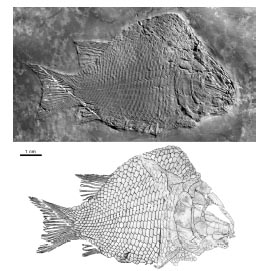
Xu, G. -H., and F.- X., Wu. 2011. A deep-bodied ginglymodian fish from the Middle Triassic of eastern Yunnan Province, China, and the phylogeny of lower neopterygians. Chinese Science Bulletin online first. DOI: 10.1007/s11434-011-4719-1.
Abstract - The Ginglymodi are a group of ray-finned fishes that make up one of three major subdivisions of the infraclass Neopterygii. Extant ginglymodians are represented by gars, which inhabit freshwater environments of North and Central America and Cuba. Here, we report the discovery of well-preserved fossils of a new ginglymodian, Kyphosichthys grandei gen. et sp. nov., from the Middle Triassic (Anisian) marine deposits (Guanling Formation) in Luoping, eastern Yunnan Province, China. The discovery documents the first known fossil record of highly deep-bodied ginglymodians, adding new information on the early morphological diversity of this group. The studies of functional morphology of extant deep-bodied fishes indicate that Kyphosichthys is not a fast swimmer but has a good performance in precise maneuvering, representing a morphological adaptation to structurally complex habitats (e.g. thick macrophyte beds, rocky areas, or coral reefs), which differs from the other members of this group. A cladistic analysis with the new fish taxon included supports the hypothesis that the Ginglymodi are more closely related to the Halecomorphi than to the Teleostei. Represented by Felberia, Kyphosichthys, and Dapedium, a highly deep and short fish body type has independently evolved at least three times in the stem-group neopterygians, ginglymodians, and basal teleosts within the lower neopterygians of the Triassic.
Largest Spider Ever Recovered is from the Middle Jurassic of China

http://news.sciencemag.org/sciencenow/2011/04/scienceshot-jurassic-spider-not.html?etoc
Sheldon, P. A., Shih, C. k., and D. Ren. 2011. A golden orb-weaver spider (Araneae: Nephilidae: Nephila) from the Middle Jurassic of China. Biology Letters online early. doi: 10.1098/rsbl.2011.0228.
Abstract - Nephila are large, conspicuous weavers of orb webs composed of golden silk, in tropical and subtropical regions. Nephilids have a sparse fossil record, the oldest described hitherto being Cretaraneus vilaltae from the Cretaceous of Spain. Five species from Neogene Dominican amber and one from the Eocene of Florissant, CO, USA, have been referred to the extant genus Nephila. Here, we report the largest known fossil spider, Nephila jurassica sp. nov., from Middle Jurassic (approx. 165 Ma) strata of Daohugou, Inner Mongolia, China. The new species extends the fossil record of the family by approximately 35 Ma and of the genus Nephila by approximately 130 Ma, making it the longest ranging spider genus known. Nephilidae originated somewhere on Pangaea, possibly the North China block, followed by dispersal almost worldwide before the break-up of the supercontinent later in the Mesozoic. The find suggests that the palaeoclimate was warm and humid at this time. This giant fossil orb-weaver provides evidence of predation on medium to large insects, well known from the Daohugou beds, and would have played an important role in the evolution of these insects.
New Ichtyosaur Material from the Middle Triassic of China
First Triassic themed paper of 2011.
Liu, J., Aitchison, J.C.,Sun, Y.-Y., Zhang, Q.-Y., Zhou, C.-Y., and T. Lv. 2011. New Mixosaurid Ichthyosaur Specimen from the Middle Triassic of SW China: Further Evidence for the Diapsid Origin of Ichthyosaurs. Journal of Paleontology 85(1):32-36. doi: 10.1666/09-131.1
Abstract - Recent cladistic analyses have all suggested a diapsid origin of ichthyosaurs. However, an intermediate evolutionary stage of the lower temporal region of ichthyosaurian skull between basal diapsids and derived ichthyosaurs has been absent from the fossil record. Here we describe the cranial skeleton of a new mixosaurid ichthyosaur specimen with a well-preserved lower temporal region from the Anisian Guanling Formation of eastern Yunnan. It is characterized by the most primitive lower temporal region within known ichthyosaurs. The primitive characters of the lower temporal region include both external and internal separation between the jugal and the quadratojugal, an anterior process of the quadratojugal, an apparent posteroventral process of the jugal, and a large lower temporal opening surrounded by the jugal, the postorbital, the squamosal, and the quadratojugal. The lower temporal region of this specimen provides the most direct evidence to the diapsid origin of ichthyosaurs. It also suggests that the disappearance of the lower temporal fenestra is caused initially by the reduction of the lower temporal arcade rather than the enlargement of the surrounding bones.
Subscribe to:
Posts (Atom)